

3 Steps To Get Into B2B Buyer Shortlist Before Day One: The Meaning of "Day Zero" And Winning It
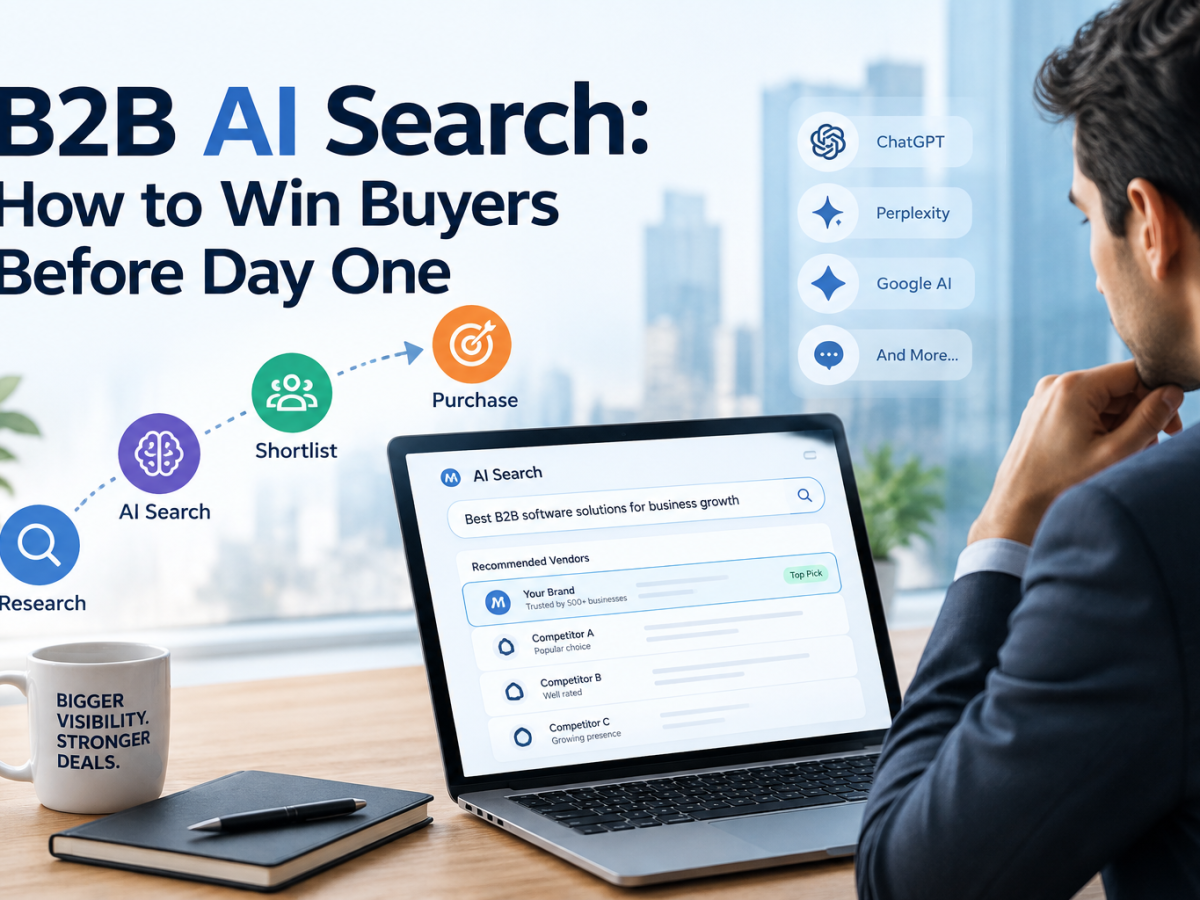
Digital marketing landscape in 2026 witnesses another big shift: the search results aren’t confined to Google anymore – there’s a completely new level of AI filtering that summarizes vendors on the buyer’s behalf before a single click is even made.
Which means that the first thing every B2B marketer should figure out right now is this: by the time a buyer asks the question, is my brand already on their shortlist?
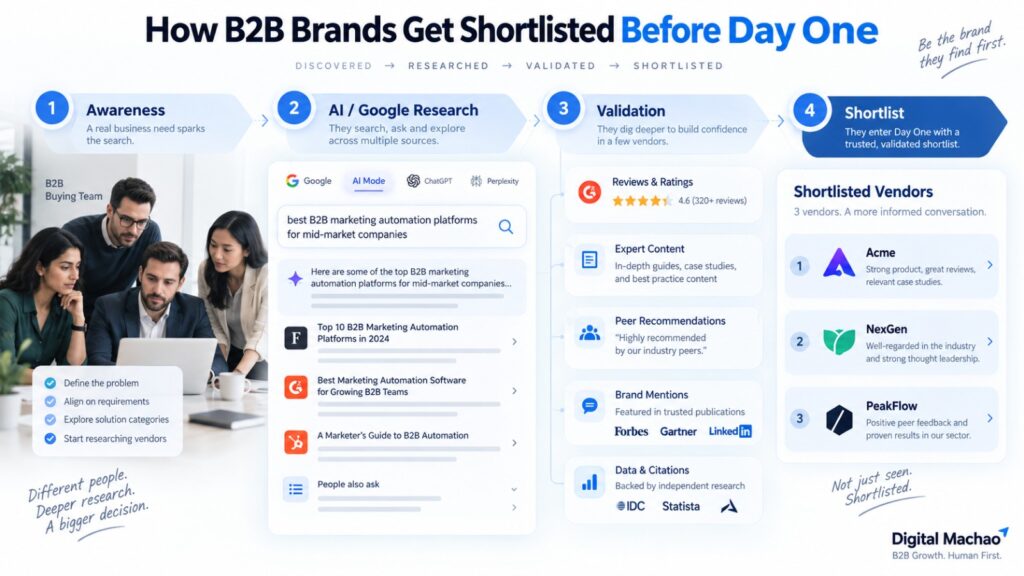
Research shows that the majority of B2B buyers use large language models (LLMs) to conduct research along with other traditional channels. Besides, a B2B buying decision isn’t made by a single stakeholder but a whole buying group who independently conducts research and builds their opinion before the meeting takes place.
Thus, having high SEO ranks becomes insufficient to get noticed – the rankings themselves still matter but aren’t enough to ensure that people pay attention.
And right here lies the essence of the “Day Zero”: it silently decides whether you will be included in the buyer’s shortlist or not. Let’s find out what it is and how to beat it.
What Exactly Is Day Zero?
As you may guess, “Day Zero” refers to the entire period before any buying activity actually takes place: that’s the moment when a buying group absorbs all the information they know about vendors within the industry (prior experience, published research, company data, peer recommendations, vendor content, product collateral, etc.).
Day 1 is the point of time when buyer’s official research starts – that’s where the typical buyer journey begins to track. But what gets formed on Day 1 is actually formed on Day Zero, way before anyone starts tracking it.
This is exactly why relying solely on AEO (Answer Engine Optimization), in other words, doing the optimization for the research phase, is not sufficient on its own. By the time when you try to secure yourself a spot in the AI-generated answers, the positions are already taken.
Studies show that, in the vast majority of cases, the deal goes to a vendor who was on the buyer’s shortlist from the very beginning. And vendors who join the list later compete for spots that were already decided.
How AI Search Has Changed Buyer Behavior
Prior to the rise of AI search tools, the buyer journey looked differently: today there are three major changes that you should notice:
1. The Search Has Compressed
Now, the comparison of vendors has become much cheaper thanks to AI, hence buyers go through the “problem-research-shortlist-purchase” cycle faster and more anonymously than ever before. Humans play a significant role in the decision-making process but by the time they start comparing options, they usually have a much narrower list and already formed opinions.
2. Extraction Matters As Much As Persuasion
Contrary to humans, AI systems don’t read a webpage as it is – instead, it extracts discrete, specific claims and cites them along with their sources. Thus, if your content lacks structure and clear statements about what exactly your product does, AI will find it hard to represent your brand correctly. According to Google itself, its generative search features are built upon core ranking and quality features – which is why SEO basics still matter. Structured content, clear claims about your capabilities, and consistent messaging across all channels remain crucial even in the era of constantly changing search interfaces.
3. Nobody Is An "AEO Expert"
To put it frankly, AEO is a relatively young sphere of marketing. Measurement methodologies are highly unstable, and many of the narratives about the AI visibility that are currently shared by brands lack proper methodology and are repeated blindly. And to make things even more difficult, platforms keep changing their rules on-the-go: something that helped your brand get cited in one quarter won’t work in the next one without giving any reasons.
But the good thing is that the Day Zero part of the equation doesn’t change in any way. Regardless of the fact whether or not your team has already mastered the latest AEO trick, a brand the buyer group already knows will always surface once they start conducting research.
Day Zero Influences Every Aspect of AEO Efforts
Opinions formed during the Day Zero affect the performance of AEO efforts in three major ways:
- Recognition Comes First. The vast majority of buyers say that the familiarity of the brand is one of the factors that affects their decision about whether a vendor should be considered at all.
- Buyers Conduct Research Independently Before Aligning as a Group. B2B buying decisions are made by a group of stakeholders who form independent opinions using AI before they meet.
- Low Confidence in AI Answers Pushes Buyers to Familiar Names. When buyers don’t have confidence in the information provided by the AI tool, the uncertain answer will push them to vendors they know and recognize.
In other words, by the time a prospect enters your CRM, they have already formed the opinion about the preferred vendor – and the decision was made somewhere where you can’t track it. AEO determines the quality of representation inside the answer generated by the AI. But Day Zero determines whether you appear there at all.
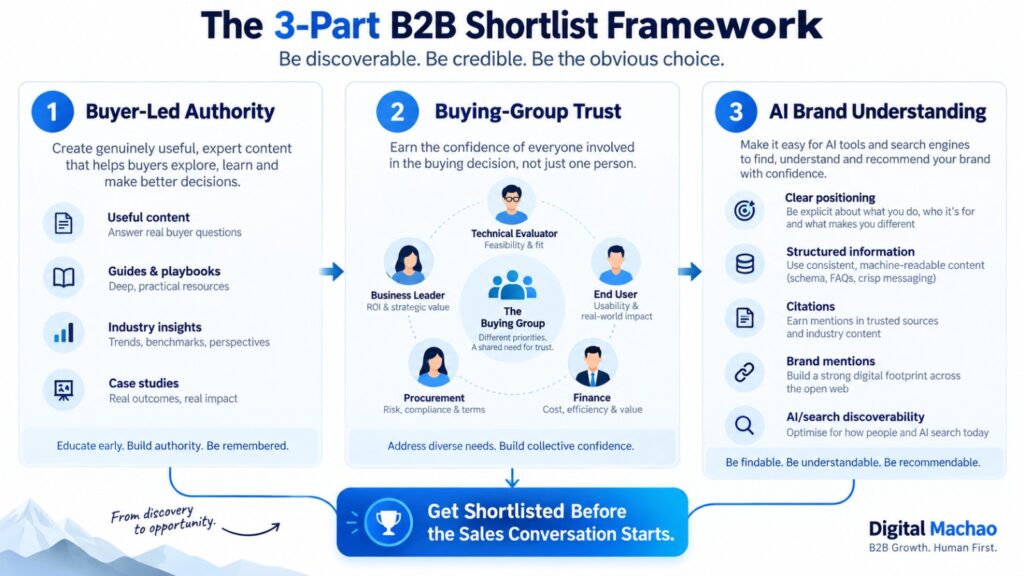
To build your influence in this period, you need to develop three specific skills.
3 Steps To Win B2B Brand Consideration
Step 1: Build Brand Authority Through Buyer-Led Content
Brand authority is basically your market presence – it’s what makes your company a recognizable name within your industry and increases the probability that buyers will remember you when they start researching a solution.
But building your brand authority requires creating buyer-led content: it’s the content that is directly relevant to your audience because it addresses their pains and answers their questions. Buyer-led content usually surfaces during the Day Zero period even without any optimization, because it possesses several features that AI models usually prioritize: it’s data-driven, original, thorough, and valuable for the reader.
Suggested KPIs to track:
- Repeat visits and time on page: people visiting your content again and spending more time on it is the best indicator that it’s really read, not just skimmed.
- Branded search volume: increase of people searching for your brand’s name means growing brand awareness. Monitor this through Search Console, trends tools, and any AEO monitoring platform that monitors brand mentions.
Step 2: Build Trust Within the Whole Buying Group
As you already know, B2B decisions are not made by a single stakeholder, but a buying group – every buyer in the group evaluates the solution from a different perspective (for example, finance evaluates the business case, IT evaluates the integration, and the end-user evaluates whether it survives real usage).
But most of AEO campaigns ignore this fact and optimize only for a single persona, letting the other buyers to form their opinions independently based on what they can find on their own.
Thus, your task is to develop precise content that addresses every stakeholder’s concerns and gives them proof of the value of your solution. For instance, a piece of content that answers the concerns of the security reviewer and makes them confident in your solution is far more effective than dozens of other content pieces irrelevant to them: it can be forwarded to other buyers, read in absence of you, and then used to prove that you’re a better solution than other vendors to the rest of the group.
Here’s how you can do it:
- Identify exactly what kind of “proof” every stakeholder role needs to have,
- Develop a content library that lets buyers independently verify the solution according to their needs.
Suggested KPIs to track:
- Roles reached per account: the number of different roles engaging with your content inside the target account tells you whether you reach the whole buyer group or just one buyer. Monitor this through your CRM and intent data from B2B review platforms.
- Return engagement from the same account: repeat visits of the same company during several weeks indicate that the buyer group researches your solution. CRM and ABM (Account-Based Marketing) platforms will let you monitor this.
Step 3: Make Your Brand Understandable to AI Systems
An AI tool can recommend only the brands it can describe. Today, a large share of buyers uses LLMs during research, but only a small share of marketers treats AEO as a real brand-discoverability initiative – hence, most of your competitors haven’t even started yet. Which is exactly the reason why you need to act now.
Here’s how you can start:
- Run an audit first. Ask the AI tool the same questions as your buyers and note whether the system mentions your brand, what it says about it, and which competitors surface.
- Expect one of the following problems: either the AI tool doesn’t mention your brand at all, or it mentions it and describes it inaccurately.
- Fix inaccurate description first since incorrect information drives the buyer away from your brand. Audit your website, especially price and product pages and make sure that the capabilities of your brand are presented accurately and consistently. Adding schema markup to those pages helps AI models to understand the capabilities even better.
Suggested KPIs to track:
- Share of voice in AI answers: the frequency of your brand mentions among the fixed set of buyer prompts. Monitor this either by repeating the prompts monthly or using a dedicated AEO monitoring platform.
- Citation accuracy: the percentage of AI answers describing your capabilities correctly. Compare this metric before and after your website audit to monitor its evolution.
Conclusion: Win Day Zero to Win AEO
On the first glance, Day Zero seems like a missed opportunity: you can’t get into it anymore, right? Actually, it’s vice versa – it’s the only stage of the buyer journey where no one is outbidding you, no algorithm is throttling your reach, and anything you create doesn’t expire with the campaign.
Your influence built during this period accumulates over time and will appear in AI interfaces both today and in the future.
It’s not primarily a technology issue: it’s about determining exactly what your brand should be known for – and presenting that information in the simplest possible way.
The mastering of Day Zero will increasingly distinguish the vendors winning the deals from the ones losing it, while AEO will become the key element of forming the brand authority needed to consider your brand.
Frequently Asked Questions
1. What does “Day Zero” mean in B2B marketing?
Day Zero refers to the entire period before any buying activity begins, during which a buying group absorbs information about vendors (prior experience, published research, peer recommendations, vendor content).
2. What’s the difference between AEO and Day Zero?
AEO (Answer Engine Optimization) decides how your brand will be described and represented once the buyer is looking for their solution. Day Zero is the earlier stage of the buyer journey which decides whether your brand will make it onto the shortlist in the first place.
3. Is focusing on AEO enough to win B2B deals?
No. Focusing solely on AEO means that you compete for spots that are already occupied by other vendors on the Day Zero.
4. How can B2B companies check their current AI visibility?
Ask AI tools (ChatGPT, Perplexity, etc.) the questions that your buyers would ask and check whether your brand appears there and how accurately it is described. It’s commonly called “AI visibility audit”.
5. What is buyer-led content?
Buyer-led content is the content created specifically to address buyers’ questions and pain points – it’s data-driven, original, and gives actionable advice that buyers can use.
6. How many people are involved in B2B buying decisions?
In today’s B2B market, purchasing decisions are usually made by several people representing various functions (finance, IT, operations, etc.), and every buyer evaluates the solution from their perspective before aligning.