
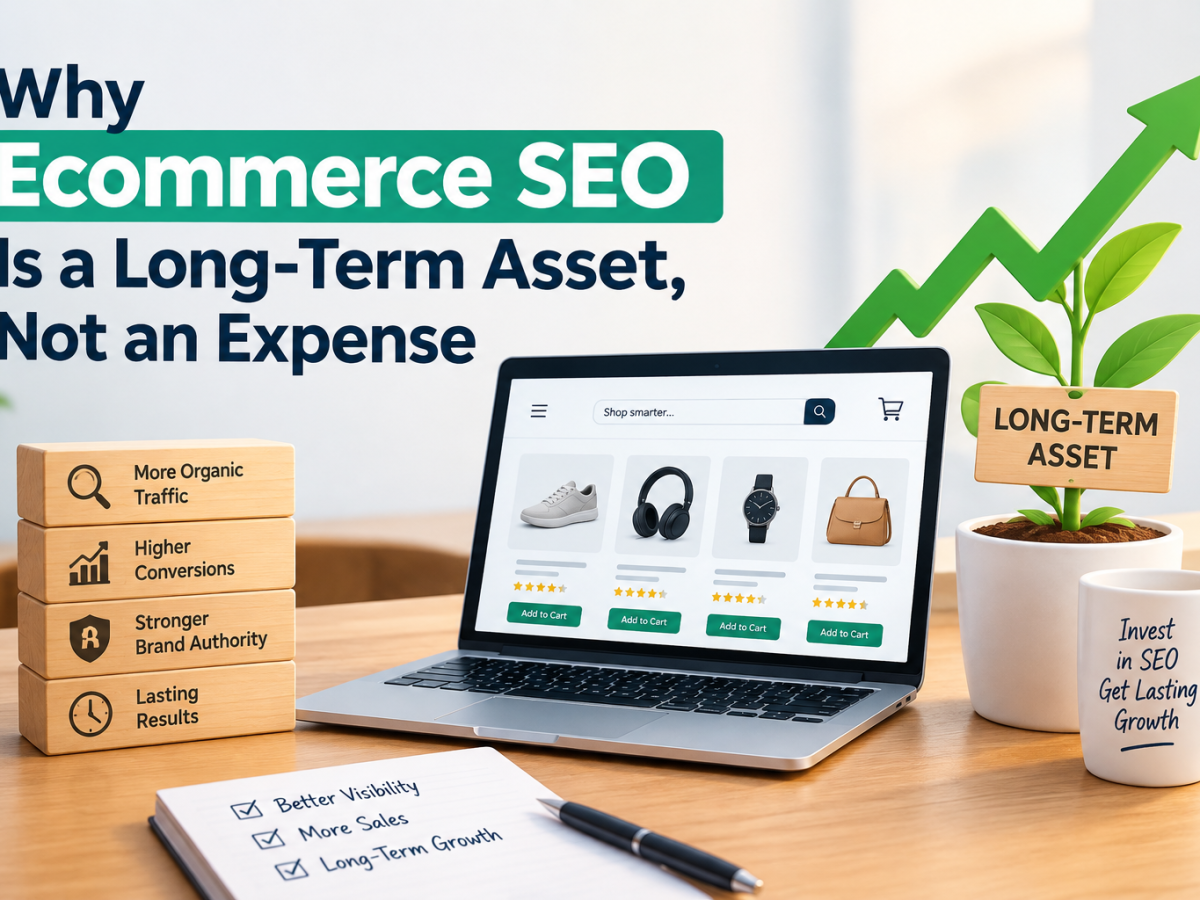

Why Ecommerce SEO Is a Long-Term Asset, Not an Expense
Every quarter, in all kinds of ecommerce companies, regardless of their size, there is this discussion that goes on, and that has quietly led to the killing of more organic growth than ever before due to a Google algorithm change: “What exactly are we getting out of our SEO efforts?”
While the question itself is not unreasonable, it contains a category error. SEO is put together with other marketing expenses and is grouped with paid media as a line item on the income statement that is then assessed based on a 30-day period. However, paid media and organic search are nothing alike. While one buys access to attention, the other builds a home.
If you have operated an online store for two or three years or more, then you know exactly what I mean. The product page you spent time optimizing back in 2023 and that continues to drive traffic and generate leads even now, the category page that has quietly become the best salesperson you have. This is not an expense, but an asset that pays dividends.
Now, here is why the distinction is crucial, and how to approach SEO in ecommerce as such.
What Makes Ecommerce SEO a Long-Term Asset?
There is a very clear principle in accounting. Expenses get used up in the period they are incurred. Assets generate benefit in several periods. Rent is an expense. A warehouse is an asset.
Paid advertising is clearly an expense. It is a cost you incur for a particular number of clicks. Those clicks can or cannot generate sales. When the credit card stops being charged, there is no more traffic. Turn off a Google Adwords campaign at 9 a.m., and by 9:05 a.m., your traffic from that channel drops to zero.
Ecommerce SEO does not act like that in the slightest. Technical improvements, information architecture, category pages, product schema, internal and external links – all this lives in the asset itself. The website is the asset, and SEO work is capital improvements to the property you own.
The reason why SEO is considered an expense is simply because it costs money on a regular basis: monthly retainers, monthly invoices, salaries of SEO specialists. This recurring payment creates a mental model, but you still pay the construction team regularly, and the result is not called an expense.
Why Ecommerce SEO Is an Investment, Not an Expense
Three properties separate assets from expenses. Organic search has all three.
1. It compounds
Traffic from paid campaigns is linear in the sense that doubling your spend doubles your clicks. Traffic from organic search is not linear because rankings lead to more rankings.
When your website ranks, it gets clicks. Those clicks and other factors signal quality. Your site gets more links and mentions simply because you can be found. These links boost your domain. A boosted domain ranks more pages. Thus, the cost of ranking your hundredth page is vastly reduced compared to the cost of ranking your tenth page.
It is the most undervalued truth about ecommerce SEO. The cost per acquisition for each new page drops with time, unlike paid marketing channels where competition raises your CPCs.
2. You own it
The Meta audience is not owned by you. The Amazon listing is not owned by you. The marketplace position is not owned by you. You pay for them and the terms can be changed at any time by the landlord.
The domain, the website architecture, the product content, the review database, and the backlink profile linking to it are owned by you. All of these assets will be transferred during the acquisition process and will be reviewed in the due diligence process. E-commerce companies that are good at acquiring organic customers through demand generation will receive higher multiples compared to those which have similar revenues but only paid traffic.
3. It depreciates slowly and predictably
Assets are temporary things that must be maintained. SEO is the same. The content gets old, the competition gets better, the algorithms change, the product range ages.
The decline isn’t a fast one, though. If you stop doing SEO, you won’t plummet; you’ll just float down gradually. That floating is the cost of maintaining your rankings, and it’s a very small fraction of the initial cost of building them.
How Ecommerce SEO Drives Long-Term Organic Traffic
Abstract arguments lose to spreadsheets, so let’s build a simple illustrative model. Numbers vary enormously by vertical — treat these as structure, not benchmarks.
Scenario: A mid-sized store spends ₹4,00,000 per month on SEO for 18 months. Total investment: ₹72,00,000.
By month 18, organic search delivers 40,000 sessions monthly at a 2% conversion rate and ₹2,500 average order value — roughly ₹20,00,000 in monthly revenue.
The naive read: “We spent 72 lakh.” The correct read: you built an asset that produces ~₹20,00,000 monthly, and crucially, continues producing in month 19, 24 and 36 without proportional new investment.
Now run the replacement-cost test — the way you’d value any asset. What would it cost to buy those 40,000 sessions monthly through paid search? At a conservative ₹25 CPC, that’s ₹10,00,000 per month, forever, escalating with competition. Your 18-month SEO investment replaces roughly seven months of equivalent paid spend — and then keeps going.
This is why SEO ROI calculations that stop at month 12 systematically understate the return. The denominator is finite; the numerator isn’t.
The Business Benefits of Ecommerce SEO
Not all SEO work compounds equally. In ecommerce specifically, four areas generate the most durable asset value.
Category and collection pages. These are the highest-leverage real estate in any store, because they target the commercial-intent head terms (“running shoes for flat feet”) that carry volume and buying intent. A well-structured category page with genuine content, filtering logic that doesn’t fracture crawl budget, and strong internal linking can outproduce hundreds of product pages.
Technical foundation. Crawl efficiency, faceted navigation handling, canonicalization, site speed, structured data. This is the least glamorous work and the most asset-like — fix it once, and every page you ever publish inherits the benefit. Skip it, and you’re building on sand.
Product page depth. Unique descriptions instead of manufacturer boilerplate, real specifications, product schema, and above all user-generated reviews and Q&A. Reviews are an appreciating asset in the purest sense: customers add to it for free, continuously, and the resulting long-tail coverage is nearly impossible for a competitor to replicate.
Topical authority and earned links. Buying guides, comparison content, and genuinely useful resources that answer pre-purchase questions. These rarely convert on first visit — which is why they get cut first — but they capture the top of the funnel, earn the links that lift the entire domain, and increasingly feed the AI-generated answers that now sit above traditional results.
How to Build a Long-Term Ecommerce SEO Strategy
Credibility requires admitting where the argument breaks. SEO becomes a genuine expense — money consumed with no residual value — in several real situations:
- When the work isn’t durable. Thin spun content, link schemes, and tactic-chasing produce rankings that evaporate. That’s spend, not investment.
- When the site can’t hold the asset. If your platform can’t render server-side, can’t control URLs, or can’t handle faceted navigation, optimization work leaks value continuously.
- When you’re structurally unable to wait. A business with six months of runway that needs revenue in 60 days should be buying paid traffic. SEO is the correct answer to a different question.
- When product-market fit is unproven. Ranking is worthless if the traffic bounces. Validate conversion with paid traffic first, then build the durable channel.
- When you’re in a sector without search demand. Truly novel products sometimes have no keyword to rank for yet.
Anyone selling you SEO who won’t name these conditions is selling you something else.
How to Measure SEO Like an Asset
If you want the organization to stop treating it as a cost line, change what you report.
| Stop reporting | Start reporting |
|---|---|
| Monthly cost vs. monthly organic revenue | Cumulative investment vs. cumulative organic revenue |
| Keyword rankings | Share of commercial-intent visibility in your category |
| Traffic totals | Revenue per organic session, and its trend |
| Channel attribution snapshots | Replacement cost — what these sessions would cost in paid |
| — | Blended CAC, with and without organic contribution |
| — | Asset decay rate: what happens to older pages over 12 months |
The two metrics that reframe the conversation fastest are cumulative return (which crosses breakeven and then never stops climbing) and replacement cost (which puts a hard rupee figure on what you’d pay to rent what you currently own).
The Realistic Timeline
Expectations cause more SEO failures than execution does. A rough shape for an established store:
- Months 1–3 — Foundation. Technical remediation, architecture, keyword and intent mapping. Visible results: minimal. This is pouring concrete.
- Months 4–8 — Traction. Long-tail and product-level rankings appear. Traffic moves. Revenue attribution starts to become defensible.
- Months 9–18 — Compounding. Category and head terms begin to rank. Growth accelerates because of the flywheel, not because spend increased.
- Month 18+ — Yield. Maintenance cost drops relative to output. The asset produces.
New domains run longer. Competitive verticals run longer still. Anyone promising head-term rankings in 90 days is describing a different, shorter-lived business model.
Frequently Asked Questions
How long before ecommerce SEO pays for itself?
Most established sites hit their breakeven point anywhere from nine to 18 months, while new domains usually need between 18 and 24 months. Breakeven is just one stage in the process; once that stage is hit, there’s still plenty more to come.
Should I choose between SEO and paid ads?
No, and the framing is the problem. Paid ads buy immediate revenue and fast testing data; SEO builds durable, owned acquisition. Most healthy ecommerce stores run both, then shift budget mix as organic matures and blended CAC falls.
What happens if I pause SEO for a few months?
You’ll likely see gradual erosion rather than a sudden drop — competitors continue publishing, content ages, technical debt accumulates. A short pause is survivable; a long one means paying part of the build cost again to recover lost ground.
Is SEO still worth it with AI search results and zero-click answers?
Of course, just not in the same way. The AI responses are compiled using high-quality, structured content. That’s right; the exact same factors that influence search ranking will influence AI-generated responses as well. And transactional searches will continue to take users to brick-and-mortar stores.
Can small stores realistically compete on SEO?
Small stores usually can’t win broad head terms early, but they can dominate specific, high-intent long-tail segments — niche product categories, specific use cases, underserved geographies. That’s how the compounding starts.
People Also Ask
1. Is SEO a capital expenditure or an operating expense?
Accounting standards generally require SEO to be expensed as incurred, since the future benefit is hard to quantify reliably. But GAAP treatment and business reality differ. Strategically, SEO behaves like capital investment: durable, compounding, and transferable on sale. Book it as opex; evaluate it as capex.
2. Does ecommerce SEO increase business valuation?
Yes. Acquirers scrutinize acquisition-channel concentration. A store with substantial organic revenue and diversified traffic presents lower risk and lower dependency on rising ad costs, which typically supports a stronger multiple than a paid-dependent business of equal revenue.
3. What’s a reasonable ecommerce SEO budget?
Most stores land between 5% and 15% of marketing budget, scaled to catalogue size, competition, and technical debt. The more useful question isn’t the monthly figure — it’s total investment to breakeven, measured against the replacement cost of equivalent paid traffic.
4. Why is my organic traffic growing but revenue isn’t?
Usually an intent mismatch: you’re ranking for informational queries rather than commercial ones, or the traffic lands on pages that don’t route toward purchase. Segment organic sessions by intent, check revenue per session by landing page type, and rebalance toward category and product pages.
5. How is ecommerce SEO different from regular SEO?
Scale and structure. Ecommerce involves thousands of URLs, faceted navigation, out-of-stock and discontinued product handling, duplicate-content risk across variants, and product schema requirements. Technical architecture and category-level strategy carry far more weight than they do on a content site.