
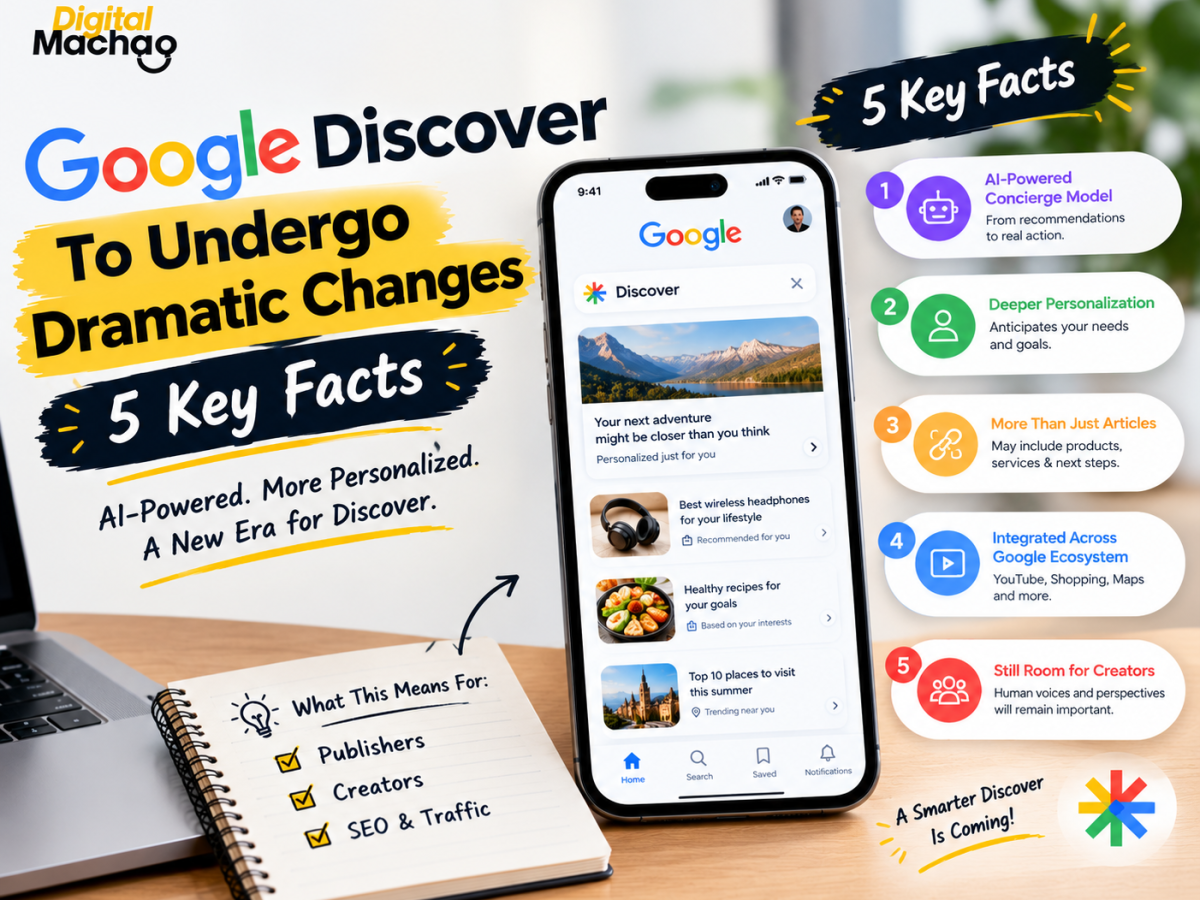


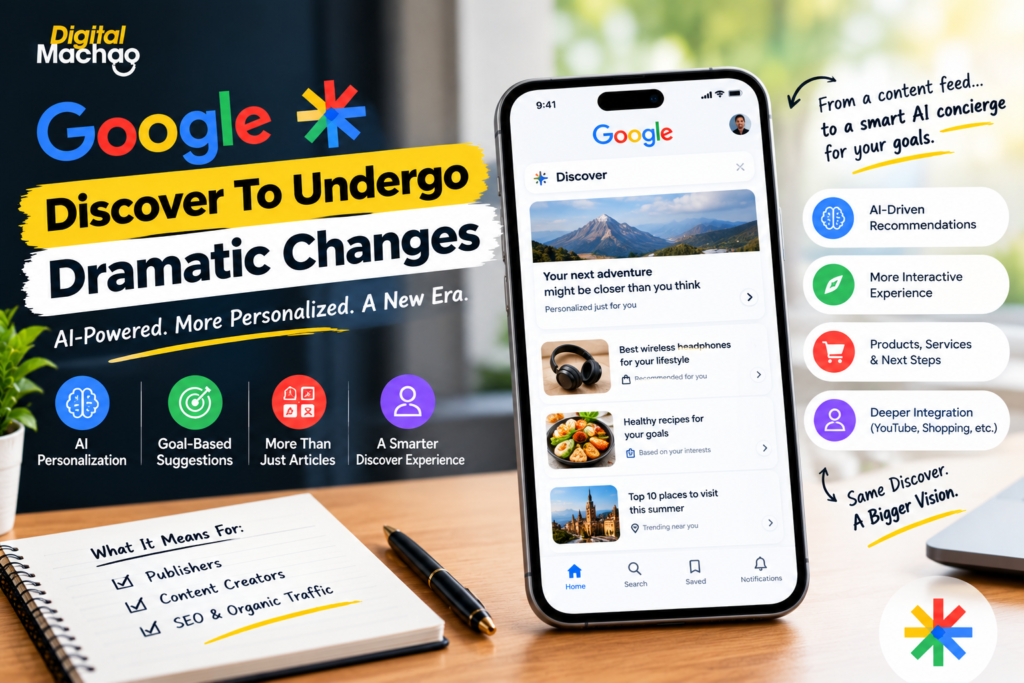
Google Discover To Undergo Dramatic Changes
Introduction: Google Discover To Undergo Dramatic Changes, Based On A Quiet But Telling Signal
Sometimes the biggest hints about where a product is headed don’t come from an official announcement — they come from a job listing. That’s exactly the case here. Google Discover to undergo dramatic changes is the conclusion drawn by Roger Montti of Search Engine Journal, based on a Google job posting for a Principal UX Lead for Discover that reveals far more about the platform’s future direction than any press release has so far.
At digitalmachao.com, where we track Google product shifts and SEO-relevant news closely, this particular signal stood out because of how specific the language in the posting actually is. It’s important to be clear from the outset: this is a signal, not a confirmed product announcement. Google hasn’t formally unveiled a redesigned Discover experience. But the posting itself describes a vision detailed enough that Google Discover to undergo dramatic changes looks like a reasonable read of where things are heading, not just speculation.
This article breaks down exactly what the job posting says, how it connects to Google’s broader AI strategy, and what it could mean for publishers, creators, and anyone relying on Discover traffic today.
The Core Signal: Discover Moving Toward A “Concierge” Model
Key facts:
- The job posting describes Google’s vision for Discover as a “proactive, hyper-personalized concierge experience” — language that goes well beyond the article-recommendation feed Discover has historically been.
- Instead of simply recommending articles related to a user’s interests, this concierge model is designed to help users make actual progress on their goals, anticipating needs and surfacing not just articles, but also products, services, and concrete next steps.
- This represents a fundamental shift in what Discover is meant to do: moving from a passive content feed to something closer to an active assistant that responds to what a user is trying to accomplish.
Why This Matters
This is the heart of why Google Discover to undergo dramatic changes is a meaningful development rather than a routine product tweak. A feed that recommends articles and a concierge that helps you accomplish goals are fundamentally different products, even if they share the same name and the same visual real estate on a phone screen. If Google genuinely builds Discover around this concierge framing, the entire logic of how content gets surfaced — and what kind of content gets rewarded — could shift substantially from what publishers have optimized for over the past several years.
How This Connects To Google’s Broader Agentic Search Strategy
Key facts:
- This potential shift lines up closely with public comments from Google CEO Sundar Pichai, who has described a future where many information-seeking queries evolve into agentic, task-based search — search that doesn’t just inform you, but actively does something on your behalf.
- A 2026 Google research paper on recommendation systems is also cited as relevant context, specifically one focused on inferring semantic intent and subjective “soft attributes” — essentially, systems that try to understand the deeper meaning and preference behind a request, not just its literal keywords.
- Taken together, these signals suggest Discover isn’t being redesigned in isolation — it’s being repositioned as part of a much larger company-wide push toward agentic, intent-driven AI experiences.
Why This Matters
Google Discover to undergo dramatic changes makes a lot more sense once you see it as one piece of a bigger pattern rather than an isolated Discover-specific decision. Google has been signaling this agentic direction across Search more broadly for some time now. Seeing that same philosophy explicitly written into a Discover leadership job posting suggests the company isn’t just testing the idea in isolated features — it’s actively hiring to build out this vision at a foundational, product-leadership level.
New Feed Formats And More Interactive, AI-Driven Design
Key facts:
- The job posting points toward redefining how feed interactions work, the formats content takes, and how AI-driven exploration functions within Discover — while still incorporating user interaction data the way the current feed does.
- There’s specific language about scaling AI-enabled formats and introducing new engagement mechanisms, alongside a stated goal of “elevating human voices and perspectives” within the experience.
- That particular phrase — elevating human voices and perspectives — is being read by Search Engine Journal as a potentially encouraging signal for publishers and creators, suggesting Google may be deliberately trying to avoid a redesign that squeezes out original human-created content in favor of purely AI-generated summaries.
Why This Matters
This is one of the more reassuring details buried inside an otherwise disruptive-sounding shift. Google Discover to undergo dramatic changes doesn’t necessarily mean publishers get cut out of the picture entirely — the explicit mention of elevating human voices suggests Google is at least aware of that risk and is positioning the redesign as something that incorporates creators rather than replaces them outright. Whether that intention actually holds up once the product ships is a separate question, but it’s a notably different tone than a pure AI-automation pitch would carry.
Deeper Integration Across YouTube, Shopping, Chrome, And Android
Key facts:
- The role is described as working closely across YouTube, Shopping, Chrome, and Android to build what’s framed as a more unified Google experience.
- Currently, Discover exists as a feature tied directly to Search — which is precisely why Google Search Console treats Discover performance as a subset of overall Search reporting rather than as a fully separate product.
- This cross-product integration suggests Discover could eventually pull in far more than article recommendations, potentially surfacing shopping suggestions, video content, and task-based actions pulled from across Google’s entire ecosystem.
Why This Matters
If Google Discover to undergo dramatic changes extends this far into cross-product integration, Discover stops being just a news and content feed and starts looking more like a centralized, AI-curated hub spanning nearly everything Google offers. For publishers specifically, this raises a real structural question: if Discover increasingly surfaces shopping results, YouTube content, and app-based actions alongside (or instead of) article links, the share of Discover real estate available to traditional publisher content could shrink, even if overall engagement with Discover as a product grows.
A Youth-Focused Push To Compete With Social Media Feeds
Key facts:
- The job posting specifically references product strategy aimed at youth demographics, along with language about competing directly with social media feeds on engagement and retention metrics.
- This positions Discover’s redesign not just as an SEO or search-adjacent initiative, but as a direct competitive response to platforms like TikTok and Instagram, which have historically outperformed traditional search products in younger-audience engagement.
Why This Matters
This detail reframes part of the motivation behind why Google Discover to undergo dramatic changes. If the redesign is partly driven by a need to compete with social feeds for younger users’ attention, the resulting product may lean further into short, highly engaging, algorithmically-optimized content formats — a different content environment than the article-centric feed publishers have built their Discover strategies around for years.
Early Signs This May Already Be Testing
Key facts:
- Search Engine Journal’s Roger Montti reported personally noticing Meta Threads suggestions appearing inside Discover recently — a detail that doesn’t confirm anything definitively, but does suggest some form of experimentation with non-traditional content types may already be underway.
- Combined with the job posting’s language, this observation adds a small but real data point suggesting the shift isn’t purely theoretical or far off on a roadmap — pieces of it may already be quietly testing in the wild.
Why This Matters
Early, unconfirmed sightings like this are exactly the kind of signal worth watching closely rather than dismissing. If Google Discover to undergo dramatic changes is already partially in testing, publishers and SEOs have less runway than they might assume to adapt their content strategy before a broader rollout potentially reshapes how traffic flows through the platform.
What This Could Mean For Publishers And Traffic
Key facts:
- The most significant risk flagged in this reporting is reduced referral traffic for publishers and content creators, driven by the possibility that Discover shifts away from sending users out to external articles and toward keeping them inside Google’s own AI-driven experiences instead.
- This mirrors a pattern publishers have already been navigating with AI Overviews and AI Mode in traditional search results, where answers increasingly get resolved directly within Google’s interface rather than requiring a click-through to an external site.
Why This Matters
This is the practical bottom line for anyone whose traffic strategy currently depends on Discover. Google Discover to undergo dramatic changes carries the same underlying risk that’s already reshaping traditional search: the more Google’s own interface can satisfy a user’s need directly, the less reason there is for that user to click through to an external site. Publishers who’ve built meaningful Discover traffic should treat this as an early warning to diversify traffic sources now, rather than waiting for a confirmed rollout to start adapting.
What Publishers And SEOs Should Do Now
- Don’t treat Discover as a guaranteed, stable traffic channel going forward. Even unconfirmed signals this specific are worth planning around early.
- Diversify traffic sources actively, building direct audience relationships through email, communities, and other channels that don’t depend entirely on any single platform’s algorithm.
- Watch for early product tests, like the Threads suggestions already spotted inside Discover, as potential previews of what’s coming.
- Continue producing genuinely original, human-voiced content, given the posting’s specific language about “elevating human voices and perspectives” — content that’s clearly differentiated from AI-generated summaries may be better positioned either way.
- Monitor Search Console’s Discover performance data closely over the coming months for any early shifts in impressions or click patterns that might signal the rollout has begun.
Conclusion: A Signal Worth Taking Seriously, Not Yet A Confirmed Overhaul
It’s worth repeating the key caveat here: Google Discover to undergo dramatic changes is currently a conclusion drawn from a job posting and surrounding context, not an official Google product announcement. Google hasn’t confirmed a redesign timeline, and plenty of hiring language describes ambitious future visions that take years to materialize, if they materialize at all in the form originally described.
That said, the specificity of this particular posting — the concierge framing, the cross-product integration across YouTube, Shopping, Chrome, and Android, the youth-engagement focus, and the alignment with Pichai’s own public comments about agentic search — makes this a signal worth genuinely paying attention to rather than dismissing as routine corporate hiring language. For publishers and SEOs whose traffic depends even partly on Discover, the smart move is watching closely now, rather than waiting for a formal announcement that may arrive well after meaningful changes have already begun.
Key Takeaways
- Google Discover to undergo dramatic changes, according to a job posting for a Principal UX Lead describing a shift toward a “proactive, hyper-personalized concierge experience.”
- The concierge model would move Discover beyond article recommendations, toward surfacing products, services, and next steps tied to user goals.
- This aligns with Sundar Pichai’s broader vision of agentic, task-based search, suggesting Discover’s redesign is part of a larger company-wide AI strategy.
- Deeper integration with YouTube, Shopping, Chrome, and Android is planned, which could reshape how much space traditional publisher content occupies in the feed.
- The biggest risk for publishers is reduced referral traffic, as Discover may increasingly keep users within Google’s own AI-driven experiences rather than sending them to external sites.
FAQs
1. Has Google officially confirmed Discover is being redesigned?
No. This is based on analysis of a Google job posting for a Principal UX Lead for Discover, not an official product announcement. It’s a strong signal of planned direction, not a confirmed launch.
2. What is the “concierge” model Google Discover may be shifting toward?
It’s a proposed shift from a passive article-recommendation feed to a more proactive, personalized experience that helps users make progress on goals by suggesting information, products, services, and next steps — not just related articles.
3. How does this connect to Google’s AI strategy overall?
It aligns with CEO Sundar Pichai’s public comments about information-seeking search evolving into agentic, task-based search, suggesting Discover’s potential redesign is part of a broader company-wide shift rather than an isolated change.
4. Will this hurt publisher traffic from Google Discover?
It’s a real risk flagged in the reporting. If Discover shifts toward keeping users within Google’s own AI-driven experiences rather than sending them to external articles, referral traffic to publisher sites could decline, similar to patterns already seen with AI Overviews in traditional search.
5. Is there any evidence this redesign is already being tested?
There’s at least one informal sighting — Meta Threads suggestions appearing inside Discover — that may indicate early experimentation, though this isn’t confirmed as directly connected to the broader redesign described in the job posting.
This article draws on reporting and analysis originally published by Search Engine Journal, by Roger Montti, reworked by the digitalmachao.com team to help publishers and SEOs understand what potential changes to Google Discover could mean for their traffic.