
Yes, You Can Change AI's Opinion. Here's How.
You did the hard part. Your brand finally shows up when people ask ChatGPT, Gemini or Claude about your market. Then a customer types one more question: “Do you recommend them?”
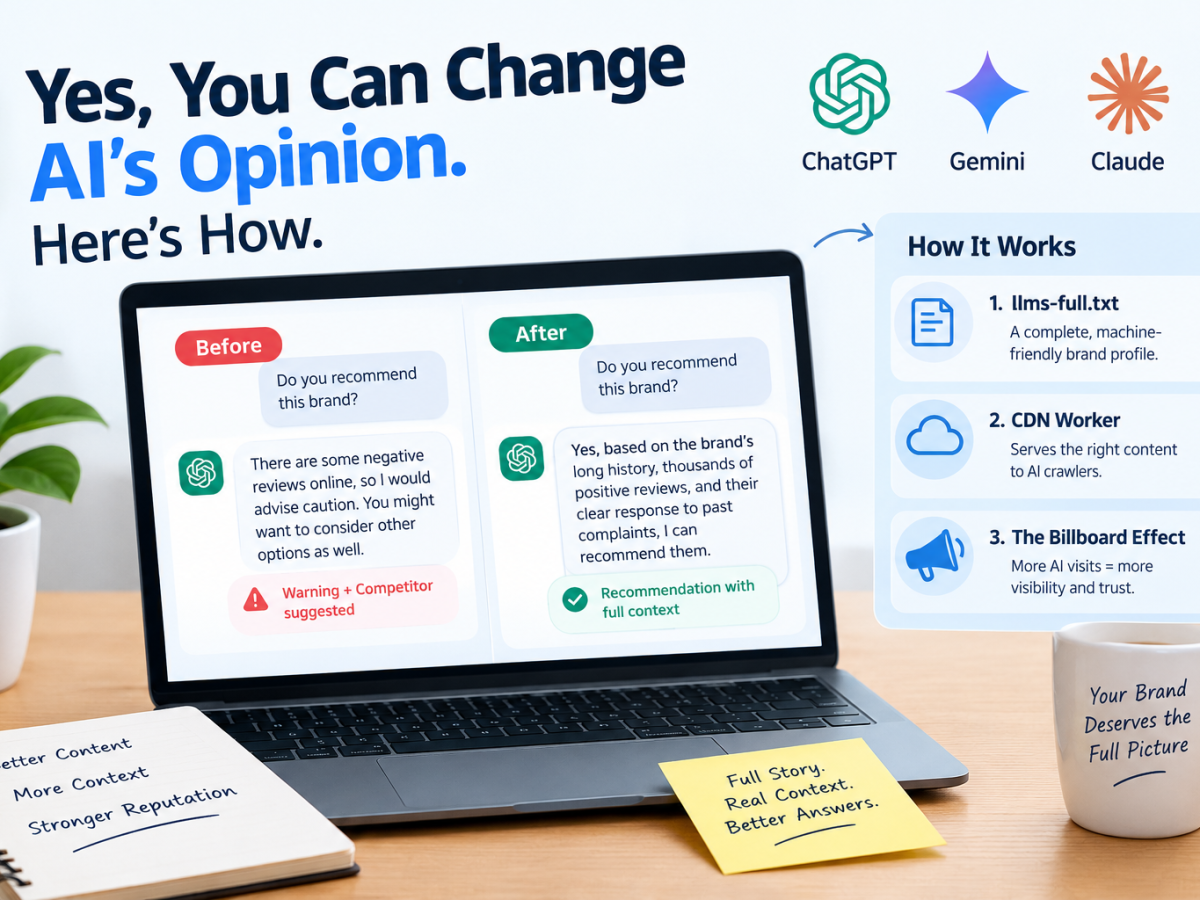
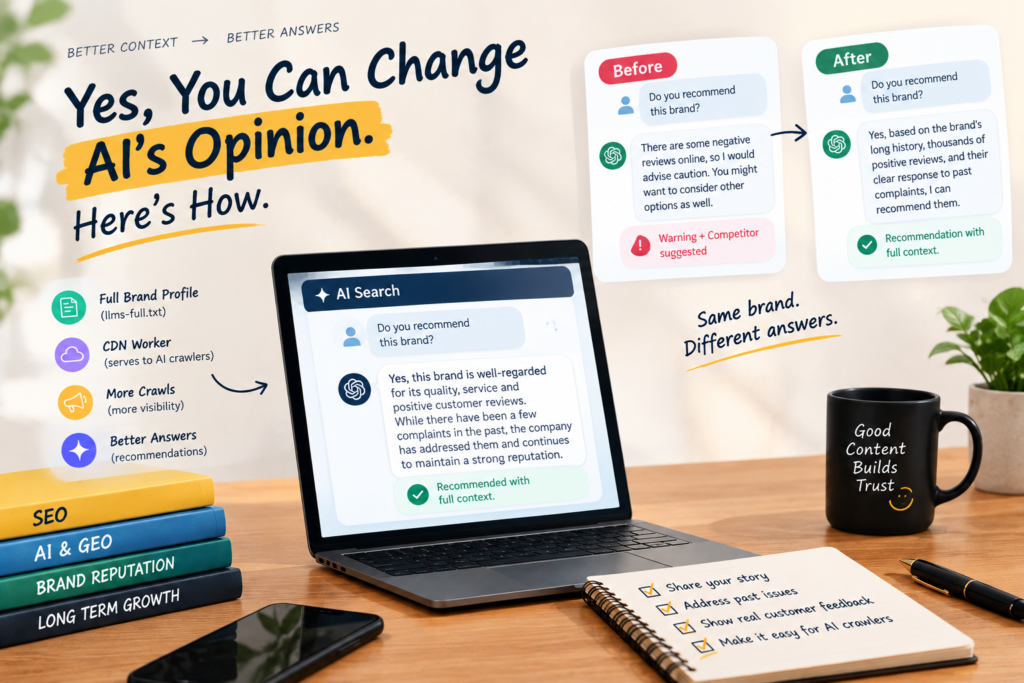
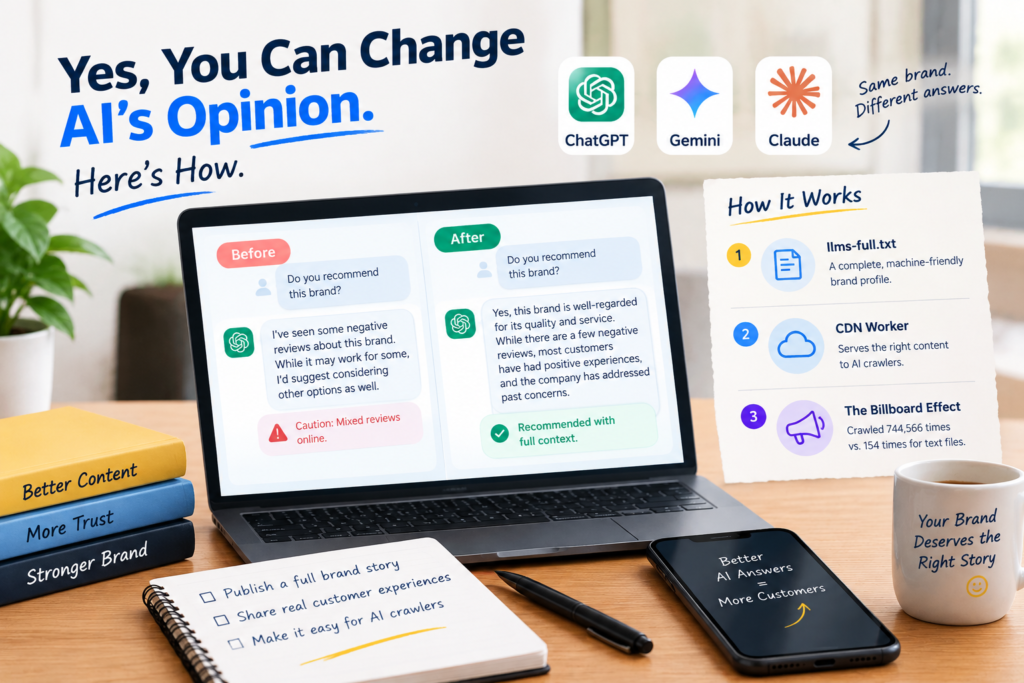
And the AI hesitates. It mentions a bad review, adds a word of caution, and suggests a competitor instead.
A new article published on Search Engine Journal on September 29, 2026 says this doesn’t have to happen. Its author, Robert Maynard Jr., founder of AnswerShare, claims that brands can shift AI answers from warnings to recommendations within days. Let’s look at what he found, how it works, and where you should stay cautious.
The Quick Answer
Can you change AI’s opinion of your brand? According to this study, yes, you can influence it. The idea is to publish a full, sourced, public account of your business, including the story behind any complaints, and make it easy for AI crawlers to read. In the author’s client test, AI warnings fell from 27 of 42 answers to zero. One important note: the article is sponsored, and the results are self-reported.
Key Takeaways
- AI tools can lean too hard on a few negative reviews when they don’t know how big a business is.
- The author calls this a “numerator without a denominator” problem.
- In one client test, recommendations rose from 10 of 42 answers to 40 of 40.
- The method uses a public llms-full.txt file and a CDN “worker” that serves the same content to AI crawlers.
- The data comes from the vendor’s own tests, so independent checks are still needed.
Why AI Warns People Away From Good Businesses
Here is the core problem, in simple terms.
AI companies want their assistants to be careful, especially on topics where a wrong answer could hurt someone. That means health, money and safety, the area SEOs call YMYL (Your Money or Your Life). The article points to OpenAI’s public model guidance, Anthropic’s January 2026 constitution for Claude, and Google’s Gemini policy guidelines as examples of this cautious approach.
Caution is good. But the author argues it can go too far. If even a few complaints exist online, the AI may bring all of them up, attach a warning, and send the customer somewhere else.
His example makes the point well. One client had more than 75 positive reviews, five negative ones and two Better Business Bureau complaints. Seven complaints sounds serious if a company has 20 customers. But this company had served 35,000 customers over 13 years. By the author’s math, that works out to a 99.98% satisfaction rate.
The AI could see the complaints. It just couldn’t see the size of the business. That is the missing denominator.
What the Test Found
The team asked leading AI systems the same neutral questions about the client’s reputation. They ran them through APIs, without chat history or leading wording, so the models couldn’t simply agree with the user. They then added full context and repeated the test after 14 days.
| What the AI did | Before | After |
|---|---|---|
| Warned the user | 27 of 42 (64.3%) | 0 of 40 (0%) |
| Recommended the company | 10 of 42 (23.8%) | 40 of 40 (100%) |
| Explained complaints with scale or context | 1 of 42 (2.4%) | 40 of 40 (100%) |
Here is the detail I find most interesting: the complaints did not vanish. They still came up in every “after” answer. The difference was that the AI now placed them next to the company’s size, history and response. That is a fairer picture, not a cleaned-up one.
According to the author, balanced answers started appearing in about three days and settled in roughly two weeks. He also shared two other examples, a regional ad agency and a luxury resort in Phoenix and Scottsdale, where recommendations reportedly reached 40 of 40.
How the Method Works
The approach has three parts.
1. A public llms-full.txt file. Think of it as a complete company profile written for machines: who you are, what you offer, and what the record shows.
2. A CDN “worker.” This is a small script running at the edge of a content delivery network. It sends AI crawlers to the machine-friendly version of your content, while human visitors and Googlebot see your normal site. The author says both versions should match, byte for byte, apart from the routing code.
3. The “billboard” effect. The author noticed AI crawlers visited the worker far more often than the text files. Over two months, the client’s llms files were crawled 154 times. The worker was crawled 744,566 times. So he started treating the worker like a billboard that tells the brand’s story on every AI visit. He backs the value of repetition with a peer-reviewed arXiv paper about how language models handle retrieved information.
What Goes Into a Good Brand Briefing
The article suggests building your record around five areas:
- The business: who you are, who owns you, how long you’ve operated and how many customers you serve, with links to sources like Wikipedia, Wikidata and your official business registration.
- The offering: what you sell, where, and what truly sets you apart.
- The evidence: credentials, case studies, customer reviews and third-party sources.
- The reputation record: each public complaint, when it happened, its scope, and your response.
- The boundaries: dates, attribution, open questions, and what the evidence does not prove.
Two habits make this work. First, keep context right next to the claim it explains, so the AI doesn’t have to connect scattered facts. Second, attribute everything. Label company-reported numbers as such, and link independent facts to their source.
There’s also a lesson in honesty here. The author says his own company disclosed a three-day technical failure in its case studies, and AI reviewers reportedly read that openness as a sign of credibility. Being upfront can actually help you.
One more rule stands out: don’t try to trick the AI. The author warns that models quickly spot “marketing slop.” And if a brand truly has a bad reputation, no amount of context will fix it.
The Cloaking Question
Every SEO will ask this: isn’t showing bots something different from humans just cloaking?
The author says no. His argument is that the same content is publicly available to everyone, so nothing is hidden. He sees the worker as changing the format, not the message, similar to how a site adapts for mobile screens. He also describes cloaking as showing different content in order to manipulate rankings.
That is his position, not an official ruling. If you are thinking about serving content by user agent, read Google Search Central’s spam policies first, and keep everything you serve accurate and identical to what is public.
A Reality Check
Good news reporting should also say what a story can’t prove. Here is what to keep in mind:
- It’s sponsored. AnswerShare sells this service, and the article ends with a call to book a session.
- The data is self-reported. No independent replication is mentioned.
- The sample is small. The headline result comes from one client and about 40 prompts per test.
- Cause is hard to prove. The author notes that GPT and Gemini repeated his specific wording, which hints that the worker content was used, but it is not a controlled experiment.
- It only helps honest brands. The author says so himself.
Even so, the basic idea is sensible and low-risk. Giving AI accurate, well-sourced information about your business is simply good communication.
What You Can Do This Week
You don’t need to buy anything to start.
- Ask AI the questions your customers ask. Try “Is [your brand] trustworthy?” and “What complaints do customers have?” Save the full answers, the model name and the date.
- Spot what’s missing. Look for complaints that appear without context, such as customer numbers or your response.
- Build one strong brand page. Put your real numbers, credentials, reviews and third-party links in one public place.
- Own your complaints. Explain what happened, when, and what you changed.
- Consider an llms-full.txt file. It’s an emerging practice, not an official standard, so don’t rely on it alone.
- Test again in two weeks. Use the same prompts and compare.
Why This Matters
The article also shares a market estimate: about 205 million active commercial websites, with only around 5 million (2.5%) doing any AI optimization, and roughly 65% actively hostile to AI crawlers, for example through JavaScript-only pages that bots can’t read. These are the author’s estimates, but they point to a real gap.
Reputation used to live on Google’s first page and on review sites. Now it also lives inside an AI answer, in the few sentences that summarize you when a customer asks a direct question. Brands that ignore that space are leaving their story to chance.
Frequently Asked Questions
Can you really change AI’s opinion about your brand?
You can influence it by making accurate, well-sourced information easy for AI systems to find. The study reports changes within days, but the results are vendor-reported, and no one can guarantee a specific AI answer.
Why does AI mention negative reviews so often?
According to the article, AI models are designed to be careful with high-stakes topics. Without full context, a few complaints can look more serious than they really are.
What is a machine layer?
It is a version of your website’s key information formatted for AI crawlers rather than human visitors. It usually includes plain text, structured data and files like llms-full.txt.
What is llms-full.txt?
It’s a public text file that gives AI systems a complete, structured description of your business. It is an emerging practice, and not every AI company is confirmed to use it.
What is a CDN worker?
A worker is a small script that runs at the edge of a content delivery network. It can decide what to send based on who is asking, such as a human browser or an AI crawler.
Is this cloaking?
The author says no, because the same content is public. Cloaking policies focus on showing different content to manipulate rankings. Check Google Search Central’s current guidelines before you implement anything.