
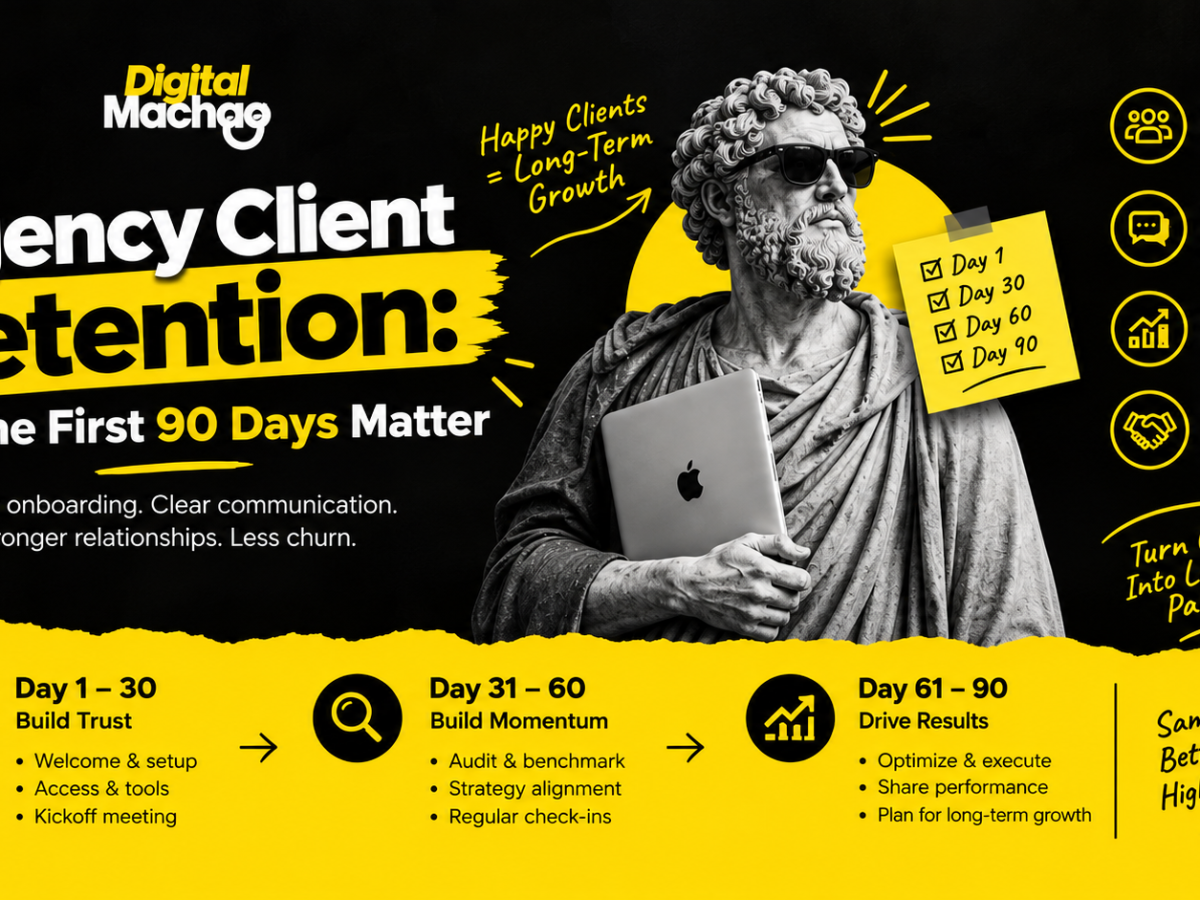



Why Agencies Lose Clients In The First 90 Days (And How To Stop It)
Very rarely do agencies lose clients due to poor performance. Clients leave within the first 90 days – well before there have been any significant results produced.
Indeed, recent 2026 research on agency churn showed that the first 90 days is the highest-risk period for agencies, across all agency models reviewed. Agencies that conduct structured reviews at the 30-day, 60-day, and 90-day milestones report better first-year retention rates compared to agencies that fail to implement these reviews.
It’s because during this period, your clients make a silent but very important decision whether they made the right choice by hiring you or not. Buyers’ remorse comes early and is based on details: how fast you are, how well-organized the first weeks were and whether the client was ever left wondering about his account.
SEO and any other marketing engagement is a long game but retention is not about six months. The decision is made within the first 90 days and it’s actually made before the first conversation with the person who will be managing the client’s account.
Here are the steps for agencies to follow in order to structure and optimize that period.
Get The Handover From Sales Right
Retention problems often begin before a campaign is even onboarded.
The moment a contract is signed, the account team needs a clean handover — the original proposal, a detailed handover brief, and clear notes on the client’s goals, anything promised around scope or timelines, and any sensitive objections raised during the sales process.
Just as important is scheduling a joint handover call with the client and their main sales contact together. This closes the gap between what sales promised and what the account team believes was sold — the single most common source of early friction.
When everyone hears the same summary of scope and expectations at the same time, there’s no room for mismatched assumptions to creep in later.
Move Fast In The First 24 Hours
Send a welcome email within 24 hours of signature.
The excitement and momentum built during the sales process fades fast if the client hears nothing for several days. A quick, organized welcome message reinforces that the project is already moving.
That first email should set up the shared communication channel, request the access you’ll need (analytics, Search Console, the CMS, and so on), and include an onboarding questionnaire built around the specific business — not generic boilerplate. Useful questions include who the client’s core customers are, what makes their business different from competitors, their biggest current challenges, and what success actually looks like to them.
Speed here isn’t just politeness. It’s the first real proof point that this agency is organized and easy to work with.
Make Sure The Client Always Knows What Happens Next
This is one of the biggest retention levers — and one of the easiest to overlook.
Clients need to know, in plain language, what’s happening next, who owns what, and when they’ll hear from you again. Most agencies don’t lose clients over performance. They lose them because the client genuinely doesn’t know what’s going on, and silence gets read as inactivity.
Set this expectation early and reinforce it consistently through the first 90 days. Slow responses and quiet stretches build buyer fatigue faster than most agencies expect.
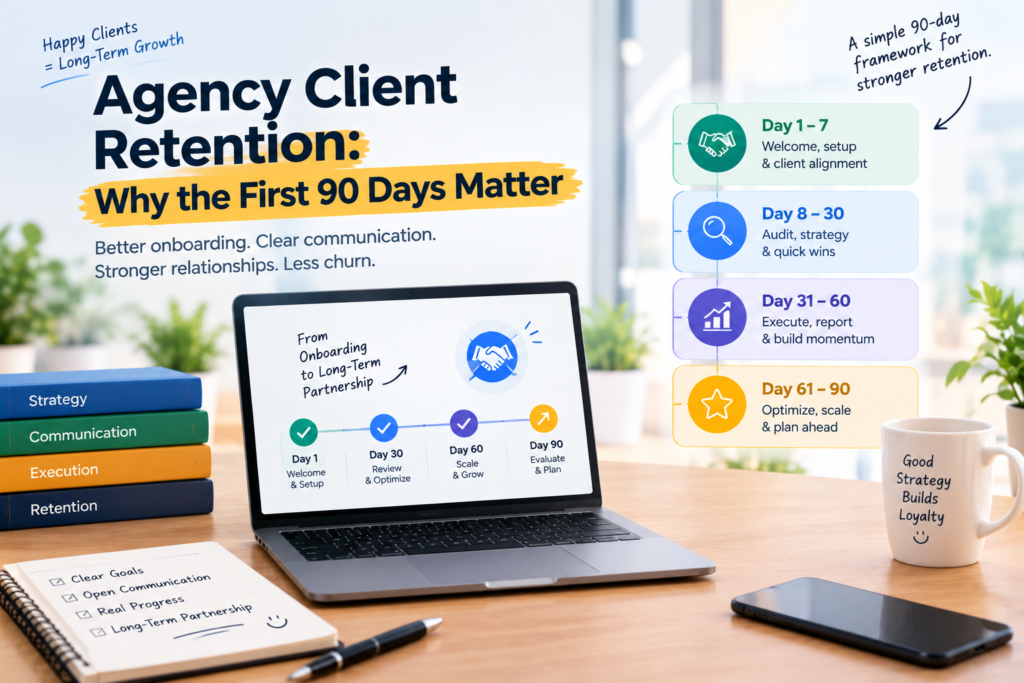
Week 1: The Kickoff Meeting
A kickoff meeting should connect the client’s actual business goals to the strategy — not just be an intake form with a “hello” attached. Four areas need to be covered:
- Business discovery: revenue goals, lead targets, seasonal trends, priority products or services, target audiences, and past marketing performance.
- Stakeholder alignment: who the decision-maker is, the day-to-day contact, technical stakeholders, and content approvers.
- Success metrics: agreeing what “success” looks like and how it’s measured — leads, revenue, organic traffic, keyword visibility, or AI search visibility — tied to what the decision-making executives actually care about.
- Competitive landscape: who the client considers a competitor, who prospects compare them against, and where they feel they’re losing ground.
Deliverable: a documented strategy summary shared within 48 hours, showing the client their input directly shaped the plan.
Week 2: The Baseline And Audit Presentation
Skip the overwhelming, jargon-heavy audit document. Present a clear, easy-to-digest benchmark report covering current traffic, rankings, leads, conversions, and revenue contribution across organic and AI channels.
Then split opportunities into three buckets: quick wins (metadata, internal linking, technical fixes), mid-term wins (content gaps, commercial page build-outs), and long-term wins (authority building, brand visibility, AI search optimization). Rank everything on a priority roadmap by impact versus effort with a clear timeline attached.
The retention benefit here is simple — instead of a long list of problems from a generic audit, the client walks away with an action plan.
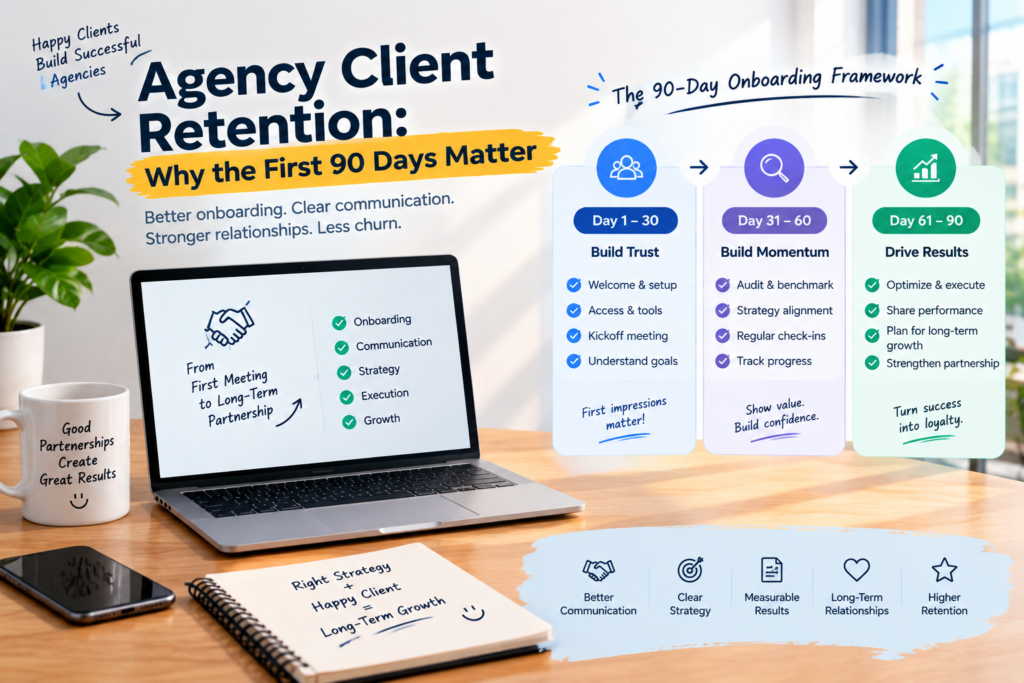
Days 15 To 30: The Early Wins Phase
Nothing builds client confidence like visible progress. One of the most common criticisms of SEO is that it feels unquantifiable because results take time — but that doesn’t have to be true when a client can physically see work happening.
Early quick wins worth prioritizing include fixing indexing issues, resolving broken redirects and pages, correcting canonicals and sitemap issues, improving title tags and internal linking, and fixing analytics and conversion tracking so future results can actually be measured.
Layer in weekly updates in a consistent format — what’s done, what’s in progress, what’s next — so the client never has to wonder if anything is happening.
Deliverable: the first “wins report.” Even before rankings move, show fixed issues, optimized pages, improved tracking, and removed technical debt.
The Day 30 Review
This is a more detailed version of a standard monthly report — one that shows progress against the roadmap shared in week two, along with key insights discovered along the way (search intent findings, competitor moves, content gaps, technical barriers) and a preview of month two’s priorities.
The retention value here comes from showing both movement and strategic evolution, not just a status update.
Days 30 To 60: Building The Growth Foundation
With the technical foundation in place and quick wins cleared, shift toward initiatives that drive longer-term growth. This typically means a content strategy built around topical gaps and commercial opportunities, an authority strategy covering link acquisition and citation-building (including digital PR where budget allows), and an AI search strategy focused on structured data, entity building, and discoverability.
Deliverable: a content calendar, publishing schedule, and link strategy plan shared with the client so they can see consistent, ongoing work.
The Day 60 Strategic Review
This is where the conversation should shift from tasks to business outcomes. Review visibility metrics (keyword movement, share of voice, AI visibility), traffic metrics (organic growth, landing page performance), and conversion metrics (leads, sales, assisted conversions) — then tie all of it back to the business results the client actually cares about, even if you’re still only seeing early leading indicators at this stage.
Days 60 To 90: The Scaling Phase
This phase moves the account from setup into sustained growth, where earlier months’ work starts to compound. Focus areas typically include new content — landing pages or topic clusters that deepen topical authority — continued authority building through links and mentions, technical enhancements like crawl optimization and structured data, and conversion rate optimization where bottlenecks or UX issues are holding back results.
Day 90: The Executive Business Review
This is arguably the most important retention meeting of the entire engagement — often run as a quarterly business review (QBR) or 90-day check-in — and it sets the tone for everything that follows.
Four things should be covered:
- What was completed — every deliverable, with context.
- What changed — rankings, traffic, leads, revenue, visibility.
- What was learned — the strategic insights gathered along the way.
- What’s next — the following 90-day plan, priorities, and forecasted outcomes where possible.
Wherever possible, present this in person or over a live call rather than sending it as a document. The client should leave the meeting believing the agency genuinely understands their business, has a clear plan, and is actively making progress.
5 Retention Tactics Most Agencies Miss
A few extra habits, layered on top of this framework, often separate a client who stays from one who’s quietly shopping around:
- Send a short weekly video update. A three-to-five-minute walkthrough often lands better for retention than a monthly written report.
- Build a shared, visible roadmap. Clients want to see what’s coming next, not just what already happened.
- Celebrate small wins along the way. Don’t wait for page-one rankings — flag technical fixes, indexation improvements, featured snippets, AI citations, and conversion lifts as they happen.
- Educate continuously. Spend a few minutes in every meeting teaching something — an AI search shift, a platform update, a competitor insight. Educated clients are much harder to lose.
- Track leading indicators early. Don’t rely solely on rankings or revenue in the early months. Watch indexed pages, visibility growth, impressions, engagement, conversions, and AI mentions — these usually move before traffic and revenue do.
Conclusion: Process And Communication Retain Clients Longer Than Results Alone
A strong framework doesn’t remove the need for judgment. Pay attention to how a client communicates as the engagement progresses, not just what the roadmap says should happen next — shorter replies, delayed approvals, or new unfamiliar faces on calls are all early warning signs worth flagging internally long before they turn into a cancellation.
Results retain clients. Process and communication retain them for longer.
Get the first 90 days right, and you’re not just avoiding early churn — you’re setting the tone for a relationship built to last well beyond it.
Key Takeaways
- The first 90 days are the highest-risk window for client churn, and structured 30/60/90-day check-ins measurably reduce first-year churn.
- Speed and clarity in week one matter more than perfect strategy. A fast, organized welcome and kickoff builds more early trust than flawless execution delivered slowly.
- Visible progress beats waiting for big results. Quick technical wins and consistent weekly updates keep clients confident while long-term strategy compounds in the background.
- The Day 90 review sets the tone for the entire relationship. A clear account of what was done, what changed, what was learned, and what’s next turns a first quarter into a long-term partnership.
Frequently Asked Questions
1. Why do most agencies lose clients in the first 90 days?
Because retention is largely decided by trust and communication, not results. Clients form an opinion about the partnership based on responsiveness, organization, and clarity long before performance data has time to show up.
2. What should happen in the first 24 hours after a client signs?
A welcome email should go out within 24 hours, setting up the communication channel, requesting necessary access (analytics, Search Console, CMS), and sharing a detailed onboarding questionnaire.
3. What’s the purpose of a Day 30, 60, and 90 review structure?
Each review builds on the last — Day 30 shows early progress against the roadmap, Day 60 shifts the conversation to business outcomes, and Day 90 is a full quarterly business review covering what was done, what changed, what was learned, and what’s next.
4. What retention mistakes do agencies commonly make?
The biggest one is silence — leaving clients unsure what’s happening with their account. Others include waiting too long to show visible wins, relying only on monthly written reports, and not tracking leading indicators before traffic and revenue move.
5. How can agencies show progress before SEO results fully kick in?
By tracking and reporting on leading indicators — indexed pages, visibility growth, impressions, engagement, technical fixes, and AI citations — all of which typically move before traffic and revenue do.
6. What’s the single most important meeting in the first 90 days?
The Day 90 executive business review. It sets the tone for the entire ongoing relationship and should ideally be delivered live rather than sent as a document.