
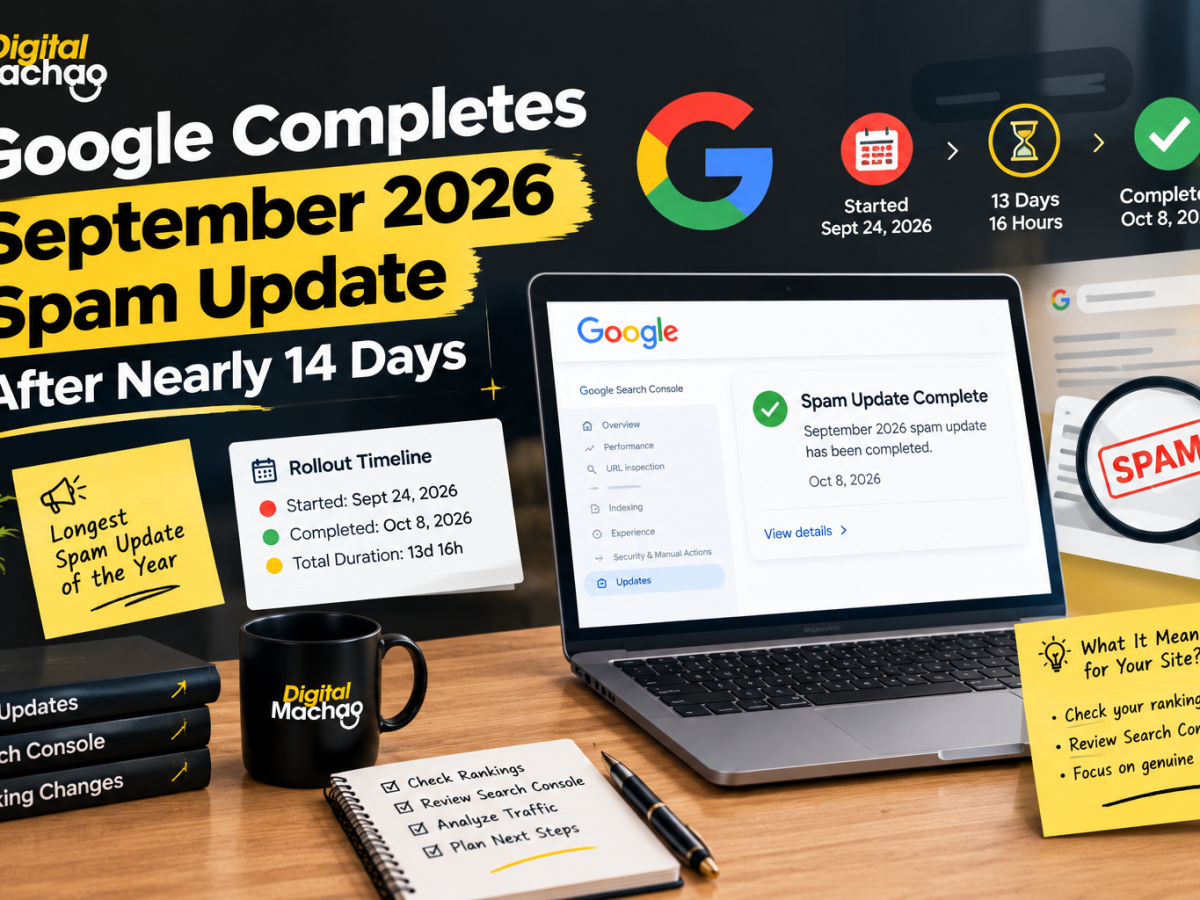



Google Completes September 2026 Spam Update After Nearly 14 Days
Introduction: Google Completes September 2026 Spam Update, But The Questions Aren’t Over
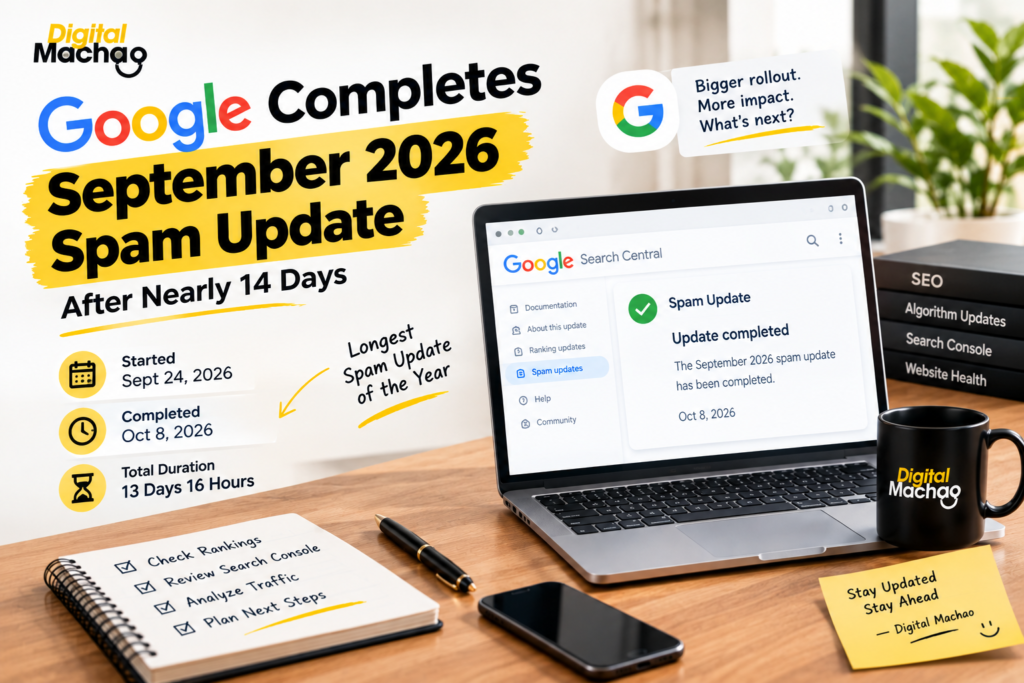
Google completes September 2026 spam update as of October 8, 2026 — closing out a rollout that took nearly 14 days, by far the longest spam update Google has run all year. For SEOs and site owners who’ve spent the past two weeks nervously refreshing Search Console, the news that Google completes September 2026 spam update brings a kind of relief, but it also opens a new phase: figuring out what actually happened, and what to do next.
At digitalmachao.com, where we track Google algorithm news and SEO developments as part of our ongoing coverage, this update stood out immediately because of how unusually long it ran compared to every other spam update this year. Now that Google completes September 2026 spam update, here’s the full timeline, how it compares to past updates, what early third-party data is showing, and the concrete steps worth taking before assuming this update is the reason behind any ranking changes you’ve noticed.
The Full Timeline: How Long It Actually Took
Key facts:
- Google’s Search Status Dashboard confirms the rollout ended at 1:00 a.m. PDT, with the update listed as complete as of October 8, 2026.
- The update originally began on September 24, 2026. At launch, Google said it would apply globally, across all languages, and could take “up to two weeks to complete.”
- Google’s own ranking update history logs the total rollout duration at 13 days and 16 hours — just shy of a full two weeks.
- As of publication, Google has not disclosed what specifically the September update targeted, or why it ran significantly longer than earlier updates released earlier in the year.
Why This Matters
The fact that Google completes September 2026 spam update almost exactly at the upper edge of its own stated two-week estimate is worth noting on its own. Google rarely gives a timeframe this specific in advance, and when it does, running right up against that limit suggests this rollout genuinely needed the full window — not that Google was simply being cautious with its initial estimate. For site owners, the practical takeaway is straightforward: any ranking or traffic movement observed between September 24 and October 8 falls inside the official rollout window, and should be read with that context in mind.
How This Compares To Every Other Spam Update In 2026
Key facts:
- The March 2026 spam update ran for just 19 hours and 30 minutes.
- The June 2026 spam update took 2 days and 1 hour.
- The August 2026 spam update ran for 2 days and 16 hours.
- By contrast, the September update — the one where Google completes September 2026 spam update after nearly 14 days — dwarfs all three earlier 2026 rollouts combined.
- For additional context, the August 2025 spam update ran for roughly 27 days, from August 26 to September 22, 2025, showing that extended spam rollouts aren’t entirely unprecedented, even if they’re unusual.
Why This Matters
Seeing Google completes September 2026 spam update after nearly 14 days immediately stands out next to a year of updates that mostly wrapped up in a few days. This kind of gap matters because it changes how confidently anyone can interpret short-term signals. A ranking fluctuation that might have resolved itself within 48 hours during the March or June updates could plausibly still be in motion for well over a week during this particular rollout, simply because Google’s systems were still actively processing and adjusting.
What Google’s Documentation Actually Says About Spam Updates
Key facts:
- Google officially describes a spam update as a notable improvement to its automated spam-detection systems — language it uses consistently across these rollouts.
- Google has not stated publicly what the September 2026 update specifically addressed, nor explained why this particular rollout took considerably longer than its three predecessors earlier in the year.
- This lack of specificity is consistent with how Google typically handles spam update disclosures — broad confirmation that systems were improved, without naming exact targets or mechanisms.
Why This Matters
Even now that Google completes September 2026 spam update, the absence of a stated target leaves site owners without a clear checklist to compare their own sites against. That’s frustrating, but it’s also fairly standard practice from Google, which generally avoids giving detailed spam-detection specifics that bad actors could use to reverse-engineer workarounds. The practical response remains the same one Google consistently recommends: review your site against Google’s published spam policies broadly, rather than searching for one specific technical cause.
What Early Third-Party Data Is Showing
Key facts:
- Analytics platform Diib analyzed 32,569 sites with connected Google Analytics accounts during the rollout window. The median share of visits coming from unpaid Google search fell from 34% to 31% across the sample.
- Within that same dataset, 10% of sites saw their organic search share drop by half or more, compared to just 5% of sites in Diib’s earlier comparison period.
- Diib was careful to frame this as “an early read, not a verdict,” noting explicitly that the data doesn’t identify which specific sites Google actually flagged as spam versus sites affected by unrelated fluctuations.
- Separately, rank-tracking platform SEOmonitor reported that many third-party rank trackers showed sudden, dramatic ranking changes starting around September 26 that real users searching Google weren’t actually seeing. SEOmonitor attributed this to incomplete or inconsistent results being returned to the automated, bot-driven searches that rank trackers rely on.
- SEOmonitor also noted an important distinction: genuine spam-related ranking changes tend to persist for several consecutive days and show up clearly in Search Console impressions and clicks data — unlike the brief, inconsistent spikes some rank trackers displayed.
Why This Matters
Now that Google completes September 2026 spam update, this early data offers a useful gut-check against panic. A 3-percentage-point median drop in organic share across tens of thousands of sites is a real signal worth watching, but it’s an aggregate figure across a huge, varied sample — not a prediction for any individual site. Meanwhile, the rank-tracker discrepancy SEOmonitor flagged is a genuinely important reminder: during an active, extended rollout like this one, third-party rank trackers can show volatility that has nothing to do with your actual rankings or with Google’s spam systems at all, simply because Google was serving inconsistent results to the automated tools scraping its results pages.
What To Actually Check In Your Own Data
Key facts:
- The September 24 to October 8 window gives every site owner a fixed, official timeframe for directly comparing Search Console performance from before, during, and after the update.
- A dip observed somewhere inside this window does not automatically mean the spam update caused it — correlation within the rollout dates is a starting point for investigation, not proof.
- The most reliable signal to trust is a decline that lasts several consecutive days and is visible in actual Search Console impressions and clicks data, rather than a brief swing on a third-party rank-tracking dashboard.
- Google’s standing advice for any site that believes it was affected by a spam update is to review its spam policies directly, and to understand that improvements made after an update may take months to be recognized by Google’s automated systems — recovery is not instant even after fixes are made.
Why This Matters
With the news that Google completes September 2026 spam update now confirmed, the real work for most site owners starts here. Rather than reacting to a single dashboard number or a scary-looking rank tracker alert, the disciplined approach is: pull your own Search Console data across the full September 24–October 8 window, look specifically for a sustained multi-day decline in impressions and clicks (not just a temporary wobble), and only then start reviewing your site against Google’s spam policies if that sustained pattern actually shows up. And if it does, patience matters — Google has been consistent in saying that recognizing genuine improvements can take months, not days.
A Practical Checklist Now That The Update Has Completed
- Pull your Search Console data for September 24 through October 8 and compare it against your baseline from the weeks before the rollout began.
- Look for sustained, multi-day movement in impressions and clicks — not single-day spikes, which are more likely to be noise.
- Treat third-party rank-tracker alerts with caution during and immediately after this window, given SEOmonitor’s reported discrepancies between tracker data and actual user-facing results.
- If a genuine, sustained decline shows up, review your site honestly against Google’s published spam policies rather than guessing at a specific cause.
- Set realistic expectations for recovery. Even confirmed fixes may take months to be reflected in Google’s systems, so don’t expect an immediate bounce-back after making changes.
- Avoid making large, reactive site changes based on noisy short-term data — confirm a real pattern first, then act deliberately.
Conclusion: The Rollout Is Over, But The Real Analysis Starts Now
Google completes September 2026 spam update after a notably long, nearly two-week rollout — the longest of any spam update released in 2026 so far. That length alone makes this update worth paying closer attention to than most, both because of what it might signal about the scale of changes Google made, and because of how much more opportunity there was for noisy, inconsistent data to show up in third-party tools during such an extended window.
The right response isn’t to panic over every dashboard fluctuation from the past two weeks. It’s to do the quieter, more reliable work: check your own first-party Search Console data against the official rollout dates, separate genuine sustained declines from short-term noise, and only act once a real pattern is confirmed.
Key Takeaways
- Google completes September 2026 spam update on October 8, 2026, after a rollout lasting 13 days and 16 hours — nearly the full two weeks Google originally estimated.
- This was by far the longest 2026 spam update, dwarfing the March, June, and August updates, which each completed in under three days.
- Google has not disclosed what this update specifically targeted, consistent with its usual approach to spam update disclosures.
- Early third-party data shows a real but moderate shift — a median organic search share drop from 34% to 31% across a sample of over 32,000 sites — described explicitly as an early read, not a conclusive verdict.
- Rank-tracker volatility during this window may not reflect real rankings, due to inconsistent results served to automated scraping tools during the active rollout.
FAQs
1. When did Google complete the September 2026 spam update?
Google completes September 2026 spam update as of October 8, 2026, at 1:00 a.m. PDT, according to Google’s Search Status Dashboard. The total rollout lasted 13 days and 16 hours.
2. Why did the September 2026 spam update take so much longer than earlier updates this year?
Google hasn’t publicly explained the reason. For comparison, the March, June, and August 2026 spam updates each completed in under three days, making the September update’s nearly 14-day rollout a significant outlier for the year.
3. What did the September 2026 spam update actually target?
Google has not disclosed specific details about what this update addressed. Google generally describes spam updates broadly as improvements to its automated spam-detection systems, without naming exact targets.
4. How can I tell if my site was genuinely affected by this spam update?
Check Search Console for a sustained, multi-day decline in impressions and clicks specifically within the September 24 to October 8 rollout window. A brief fluctuation on a third-party rank tracker is less reliable evidence than a consistent pattern in your own first-party Search Console data.
5. If my site was affected, how long will recovery take?
Google has consistently stated that even after genuine improvements are made, it can take months for its automated systems to recognize those changes and adjust rankings accordingly. Recovery is not immediate.
This article draws on reporting originally published by Search Engine Journal, reworked by the digitalmachao.com team to help site owners understand the September 2026 spam update timeline and what to check in their own data.