
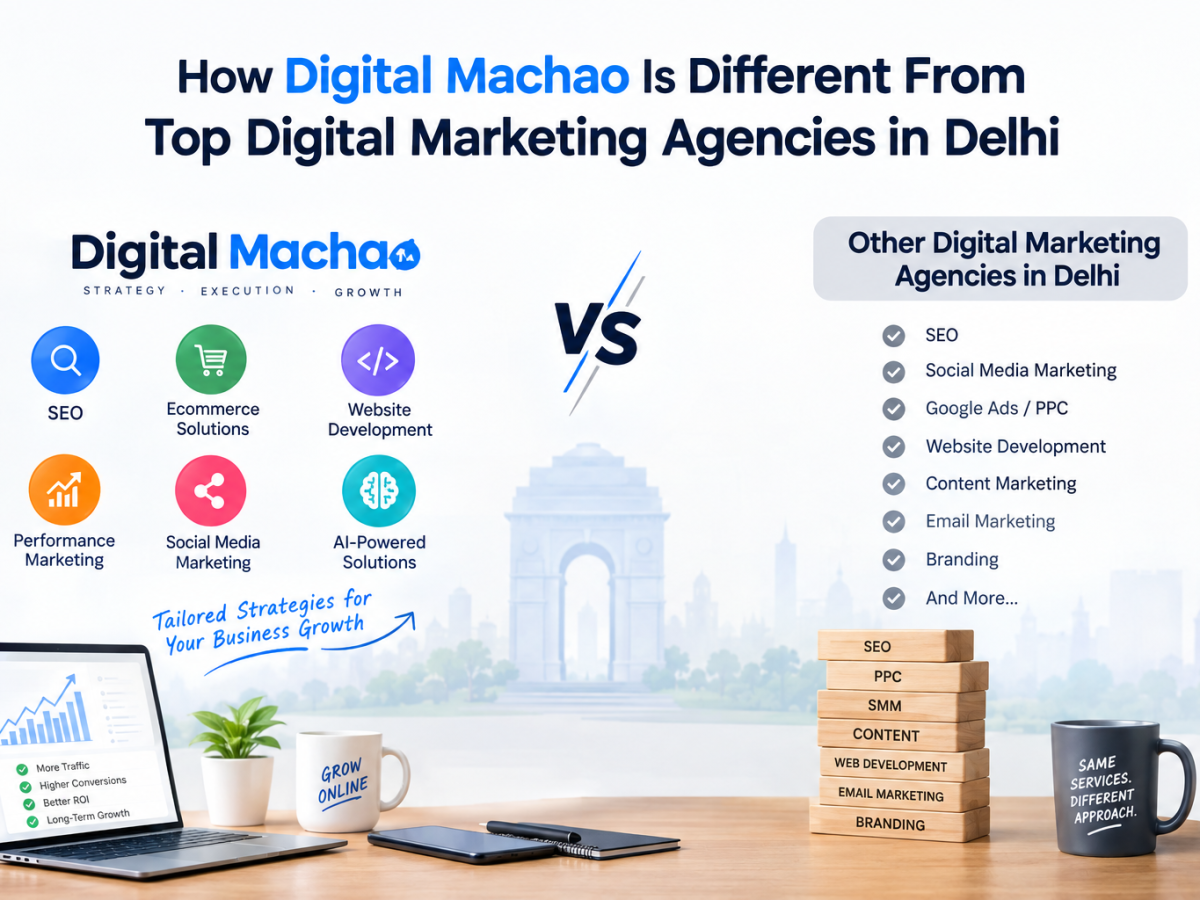

How Digital Machao Is Different From Top Digital Marketing Agencies in Delhi
Type “digital marketing agencies in Delhi” into Google and you’ll get roundup articles listing the same 10–15 names, usually ranked by nothing more transparent than who paid for the placement or who has the most LinkedIn followers. Delhi genuinely has hundreds of agencies — from decade-old firms with hundreds of employees to two-person setups running out of a co-working space — and almost none of the “Top 10” lists explain how they arrived at that ranking or what actually separates one entry from the next.
If you’re a business owner trying to pick a partner from that list, the honest answer is: the list itself won’t tell you much. What tells you something is a proper framework for comparison — and then applying that framework to see where a specific agency, like Digital Machao, actually differs.
This isn’t a takedown of Delhi’s agency ecosystem. Many of the agencies that show up on those lists are genuinely capable. The goal here is to give you the criteria to evaluate any of them properly, and to be transparent about where a specialist-leaning agency’s approach tends to diverge from the market norm.
Why "Top Agency" Lists Don't Actually Help You Choose
Most Delhi agency roundups are built from one of three inputs: SEO visibility (who ranks for “digital marketing agency Delhi”), directory listings (Clutch, GoodFirms, and similar platforms where agencies pay for enhanced profiles), or simple longevity (agencies that have existed longest accumulate the most mentions).
None of these three signals tell you whether an agency will solve your specific problem. A firm that ranks #1 for “digital marketing agency Delhi” is good at marketing itself — which is a real skill, but a different skill from running your paid campaigns or fixing your site’s crawl issues. A firm with the most Clutch reviews may simply have the most efficient review-request process.
This is why the more useful exercise isn’t “who’s on the top-10 list” — it’s building your own shortlist against a handful of concrete criteria, then testing agencies against them directly.
A Better Framework for Comparing Delhi Agencies
1. Specialization vs. generalist breadth
Most Delhi agencies market themselves as full-service — SEO, PPC, SMM, web development, content, sometimes even offline media — under one roof. That breadth is genuinely useful when you need multiple channels coordinated tightly (a product launch, a rebrand). It’s a liability when your actual problem is narrow and deep — a technical SEO issue, a specific paid-media inefficiency, an ecommerce catalogue structure that’s fighting itself in search.
Where this matters: ask any agency directly what percentage of their work concentrates in one discipline versus being spread evenly across all of them. An agency whose SEO or performance-marketing work is a smaller slice of a much broader pie will, on average, have less repetition-built pattern recognition in that specific discipline than one whose practice is weighted toward it.
2. Reporting depth: activity metrics vs. outcome metrics
Nearly every agency will show you a monthly report with rankings, impressions, and traffic charts. Far fewer will show you revenue-adjacent numbers — conversion rate by channel, cost per acquisition trends, revenue per organic session — because those numbers are harder to produce and harder to hide behind if they’re flat.
Where this matters: ask to see a sample report before signing anything. If it stops at “rankings improved” and “traffic is up,” push for what those movements actually did to leads or sales.
3. Transparency about timeline and limitations
A pattern worth watching for across Delhi’s agency market: promises of fast, guaranteed results — “first page in 30 days,” “guaranteed leads.” SEO and most durable digital channels do not work on guaranteed short timelines; anyone promising otherwise is either describing a paid-media tactic mislabeled as SEO, or setting an expectation they can’t actually control.
Where this matters: an agency willing to tell you what won’t work, or where results will take longer than you’d like, is giving you more useful information than one telling you everything is fast and guaranteed.
4. Technical depth versus surface-level execution
Especially in SEO and ecommerce, the difference between agencies often isn’t visible in a sales pitch — it shows up in whether they can diagnose specific technical problems (crawl budget issues, canonicalization, schema implementation, platform-specific quirks on Shopify, WooCommerce, or Magento) rather than defaulting to generic content and link-building activity.
Where this matters: ask a technical question specific to your website during the sales conversation, not after signing. The specificity of the answer tells you more than any case study slide.
5. Client concentration and fit
An agency that has worked primarily with SaaS and B2B clients may not transfer well to ecommerce, and vice versa — the channels, metrics, and buyer behavior differ substantially. Ask what proportion of current clients look like your business, not just how many clients the agency has in total.
Where a Focused Approach Like Digital Machao's Tends to Differ
Set against that framework, a smaller, discipline-focused agency tends to diverge from the Delhi market norm in a few consistent ways — not because focus is automatically superior, but because it’s a structurally different choice:
- Narrower service concentration, usually weighted toward SEO and organic-search-adjacent work, rather than an even spread across every channel. This trades one-stop-shop convenience for depth in a smaller set of problems.
- Diagnosis-first engagement, starting from a technical or structural audit rather than a content calendar or campaign proposal, on the logic that unresolved technical debt caps the return on everything built on top of it.
- Outcome-anchored reporting that tries to connect visibility metrics to revenue or lead numbers rather than stopping at rankings and traffic, even where that means showing a less flattering month.
- Conservative, stated timelines rather than guaranteed-fast promises, because durable organic growth compounds over months, not weeks.
- Direct, specific communication during scoping — willing to say when a channel isn’t the right fit for a given business rather than selling every service regardless of fit.
None of this means a full-service Delhi agency is the wrong choice for every business — plenty of businesses genuinely need coordinated multichannel execution, and a broad team under one roof is the right structure for that. It means the fit depends on what problem you’re actually trying to solve, and it’s worth being honest with yourself about which one that is before comparing agencies.
A Practical Checklist Before You Decide
Use this against any shortlist, Digital Machao included:
- What percentage of your team’s work is in the channel I most need help with?
- Can you show me a report that includes revenue or lead numbers, not just rankings and traffic?
- What’s a realistic timeline for my specific situation, and what could make it longer?
- Ask a specific technical question about your own website or campaign — how detailed is the answer?
- What percentage of your current clients are in my industry or business model?
- What have you turned down or told a client wasn’t a good fit for their business? (An honest answer here is often the most revealing.)
An agency that answers all six directly, with specifics rather than generalities, is telling you more than any “Top 10 Delhi agencies” list ever will.
Frequently Asked Questions
How do I know if I need a specialist agency or a full-service one? If your problem is narrow and deep — a technical SEO issue, a specific channel underperforming, a catalogue-structure problem — a specialist tends to bring more relevant depth. If you need multiple channels coordinated tightly under one roof, such as a product launch spanning paid, social, and PR simultaneously, a full-service agency is usually the more practical fit.
Are “Top Digital Marketing Agencies in Delhi” lists reliable? Treat them as a starting point for names, not a verdict. Most rankings are built from SEO visibility, paid directory placements, or longevity — none of which directly measure whether an agency will solve your specific problem. Use your own criteria (reporting depth, technical specificity, client fit) to evaluate any name from a list.
What questions should I ask before signing with a Delhi digital marketing agency? Ask for a sample report that includes outcome metrics (leads, revenue, conversion rate), a realistic timeline with stated caveats, and a specific technical answer about your own website or campaign given during the sales conversation, not after signing.
Is a smaller, focused agency riskier than a large full-service one? Not inherently — size and focus are different variables. A smaller agency concentrated in one discipline can bring more depth in that discipline than a much larger team spreading attention across every channel. The relevant risk factors are track record, communication, and fit to your specific business, not headcount alone.
How long should I expect to wait before seeing real results from a Delhi agency? It depends heavily on the channel and starting point. SEO and organic-search work typically show meaningful movement over months rather than weeks; paid media can show results faster but stops the moment spend stops. Any agency promising fast, guaranteed results on a channel that doesn’t naturally work that way is a signal worth questioning.
People Also Ask
1. Which is the best digital marketing agency in Delhi? There’s no single objectively “best” agency — the right fit depends on your industry, business model, budget, and which specific channel or problem you need solved. Comparing agencies against concrete criteria (reporting depth, technical specificity, client fit, realistic timelines) is more useful than relying on generic “best of” rankings.
2. How much does a digital marketing agency in Delhi charge? Pricing varies widely — from a few thousand rupees monthly for small, narrow-scope engagements to six-figure retainers for large full-service accounts. Cost typically scales with scope, team seniority, and whether the engagement is a single channel or a coordinated multichannel program.
3. What is the difference between an SEO agency and a full-service digital marketing agency? An SEO-focused agency concentrates its team, tools, and reporting around organic search specifically, while a full-service agency spreads its team across SEO, paid media, social, content, and sometimes web development and PR under one roof. The trade-off is depth in one discipline versus coordinated breadth across several.
4. How do I verify if a digital marketing agency’s claims are genuine? Ask for case studies that show outcome metrics rather than just traffic or ranking screenshots, request references you can actually contact, and pose a specific technical or strategic question about your own business during the sales conversation — vague answers to a specific question are a reliable warning sign.
5. Do digital marketing agencies in Delhi work with businesses outside Delhi or India? Yes, many Delhi-based agencies serve clients across India and internationally, particularly in SEO, ecommerce marketing, and performance marketing where physical location matters less. Location becomes more relevant mainly for services tied to local presence, such as local SEO or in-person creative production.