



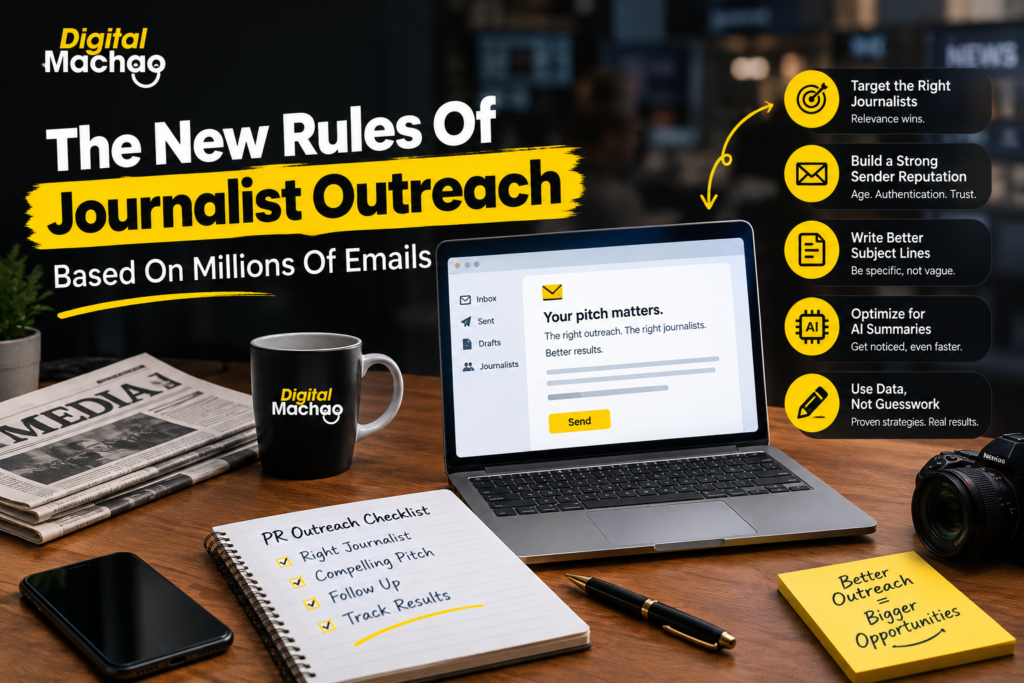
The New Rules Of Journalist Outreach, Based On Millions Of Emails
Introduction: The New Rules Of Journalist Outreach Are Written In The Data
Digital PR and link building still depend on one fragile moment: a journalist opening your email and deciding whether to read it. For years, advice on that moment came from habit and gut feeling. Now there is real data behind it.
Vince Nero, Director of Content Marketing at BuzzStream, recently published a Search Engine Journal analysis built on millions of outreach emails, including 14.3 million emails analyzed by sender domain age, 39 million analyzed by subject line, 628 AI-generated email summaries, and a 1,588-domain email authentication study. The result is a clear set of new rules of journalist outreach that every PR professional, SEO, and content marketer should know.
At digitalmachao.com, where we cover SEO, digital PR, and search news, this research stood out because it replaces folklore with numbers. This article walks through the new rules of journalist outreach, what the data shows, and how to turn it into a better pitching process.
Rule One: Relevance Beats Everything, Because Journalists Are Overwhelmed
Key facts:
- There are roughly 2 to 3 PR professionals for every U.S. journalist, though estimates vary: the Census suggests about 1.8, while the Bureau of Labor Statistics suggests about 7.2. In the U.K., the figure is about 1.5 per journalist.
- According to Muck Rack’s State of Journalism 2026 report, 47% of journalists say they seldom or never receive pitches that match their coverage.
- The article recommends targeting journalists by reviewing their last 10 to 20 articles, not just their bio or job title.
Why This Matters
This is the foundation of the new rules of journalist outreach. When nearly half of journalists say pitches rarely fit what they cover, an on-topic pitch stands out almost automatically. Relevance also protects your sender reputation, makes subject lines easier to write, and produces clearer pitches. The core conclusion of the research is that every other tactic works better once you have picked the right journalist.
Rule Two: Domain Age And Authentication Shape Whether Emails Are Even Opened
Key facts:
- Domains aged 5 to 6 years averaged a 34.9% open rate, compared with 21.6% for domains aged 1 to 2 years.
- New domains averaged about 25% opens for both experienced and new senders, which suggests domain age matters more than sender skill in the early period.
- Young domains with full authentication still averaged 17.9% opens.
- Fully authenticated domains using SPF, DKIM, and DMARC averaged 30.1% opens, versus 7.8% for unauthenticated domains, roughly four times better.
- Google, Yahoo (2024), and Microsoft (2025) introduced sender requirements, and failing them can get senders blocked.
Why This Matters
Among the new rules of journalist outreach, this one is the least glamorous and possibly the most important. A brilliant pitch cannot work if it never reaches the inbox. Domain age cannot be shortcut, so the advice is to build it gradually and keep sending practices clean. Authentication, however, is fast: SPF, DKIM, and DMARC can usually be set up in DNS by a developer in under an hour. For any team doing outreach at scale, that is one of the cheapest improvements available.
Rule Three: Subject Lines Should State Specifics, Not Tease
Key facts:
- Subject lines that stated a finding reached a 43.1% open rate and a 1.37% reply rate, while lines that teased a finding reached 39.8% opens and 0.88% replies.
- Specific wording achieved 43% opens and a 1.40% reply rate. Mixed wording achieved 37.5% opens and 1.55% replies. Vague wording achieved 34.6% opens and 1.17% replies.
- Putting the key statistic in the first one to three words produced 46% opens and a 1.53% reply rate, compared with 38.9% for middle placement and 38.1% for late placement.
- Suggested length is around 60 characters on desktop and 42 on mobile, though limits vary by platform.
Why This Matters
The new rules of journalist outreach reward clarity over curiosity games. Teasing a finding may feel clever, but stating it performed better on both opens and replies. The practical method is to write the main takeaway as a full sentence first, then compress it into a subject line that leads with the key number. One detail worth noting from the data: mixed wording had the highest reply rate even though specific wording had the highest opens, so opens are not the only measure of a good subject line.
Rule Four: Write For The AI Summary Before The Human Reader
Key facts:
- The study analyzed 628 AI email summaries. The share of summary content drawn from the first half of the email was 87.1% for Google, 82.5% for Apple, and 65.4% for Microsoft.
- Bulleted text appeared in summaries 92% of the time for Microsoft, 65% for Google, and 64% for Apple.
- Personalized introductions appeared in summaries 61% of the time for Microsoft, 11% for Google, and 0% for Apple.
- Summary length varied: roughly 30 words for Google, 50 for Apple, and 150 for Microsoft.
- Apple and Microsoft summaries misrepresented the original email in about one in three cases, mainly around data and expert quotes.
Why This Matters
This may be the most forward-looking of the new rules of journalist outreach. Many journalists now see an AI-generated summary of your email before, or instead of, the email itself. Because those summaries draw heavily from the top of the message, the key information has to go there. Personalized openers rarely survive summarization, so generic flattery can simply disappear, which supports the advice to skip generic personalized openers and focus on relevance. Bullets are more likely to be carried into summaries, so use them to explain the why and how behind your takeaway without repeating it.
Rule Five: Check The Coverage, Because AI Summaries Can Get It Wrong
Key facts:
- Because Apple and Microsoft summaries misrepresented emails in about one in three cases, errors can enter a journalist’s understanding of your pitch, particularly around data and expert quotes.
- The article recommends checking published coverage for accuracy, since AI summaries may misstate the original information.
Why This Matters
This rule extends outreach past the send button. If a pitch contains a statistic or an expert quote, and an AI summary distorts it, the error could reach the published story. Reviewing coverage after it goes live, and politely requesting corrections where needed, is now part of responsible outreach. It also makes a case for short, unambiguous pitches that are harder to misread.
A Practical Checklist: Applying The New Rules Of Journalist Outreach
- Research before you pitch. Read a journalist’s last 10 to 20 articles and pitch only when your story genuinely fits.
- Authenticate your sending domain. Set up SPF, DKIM, and DMARC, and confirm the setup before launching campaigns.
- Build domain age patiently. Keep volume sensible and sending practices clean, since age cannot be rushed.
- Write the takeaway as a sentence first, then turn it into a specific subject line that leads with the key stat.
- Put the most important information at the top of the email body, where AI summaries pull most heavily.
- Use bullets for the why and how, without repeating the main takeaway.
- Skip generic personalized openers. Spend that effort on relevance instead.
- Audit published coverage for accuracy, especially numbers and quotes.
What These Rules Mean For SEOs And Link Builders
Digital PR is one of the main ways brands earn authoritative links and mentions, and AI search systems increasingly lean on trusted third-party coverage when describing brands. That makes outreach quality a visibility issue as well as a link-building one. If your pitches never land in inboxes, never get opened, or get distorted in summaries, the coverage that could build your authority never happens.
A fair caution: this data comes from one outreach platform’s dataset, and open and reply rates describe email behavior, not whether coverage or links result. Teams should treat the figures as strong directional guidance and test the rules against their own campaigns.
Conclusion: Relevance First, Mechanics Second
The new rules of journalist outreach come down to one idea that the research keeps returning to: relevance matters most. Pitch the right journalist, and sender reputation improves, subject lines become easier to write, and pitches become clearer and less likely to be distorted by AI summaries. Then handle the mechanics well: authenticate your domain, state your finding specifically, lead with the key stat, and put the important information first.
Journalists are overloaded, inboxes are filtered by AI, and email providers are stricter about senders. The teams that adapt to the new rules of journalist outreach will be the ones whose work actually gets read.
Key Takeaways
- The new rules of journalist outreach are based on millions of emails, including 14.3 million analyzed by domain age and 39 million by subject line.
- Relevance matters most. 47% of journalists say they seldom or never get pitches matching their coverage.
- Authentication works. Fully authenticated domains averaged 30.1% opens versus 7.8% for unauthenticated ones.
- Specific subject lines win. Leading with the key stat in the first one to three words produced a 46% open rate.
- Write for AI summaries. Most summary content comes from the first half of the email, and about one in three Apple and Microsoft summaries misrepresented the original.
FAQs
1. What are the new rules of journalist outreach?
They are data-backed practices for pitching journalists: target relevant reporters, authenticate your sending domain, write specific subject lines that lead with the key stat, put key information at the top of the email, and check coverage for accuracy.
2. Does email authentication really affect open rates?
According to the research, yes. Fully authenticated domains using SPF, DKIM, and DMARC averaged 30.1% open rates, compared with 7.8% for unauthenticated domains.
3. What kind of subject line works best for journalist outreach?
Stating a finding outperformed teasing one on opens and replies. Putting the key statistic in the first one to three words performed best, with a 46% open rate and a 1.53% reply rate.
4. How do AI email summaries affect pitches?
Many summaries draw most of their content from the first half of the email, so the key information should appear at the top. Personalized openers were rarely included, and some summaries misrepresented the original email.
5. How can I find the right journalist to pitch?
Review their last 10 to 20 articles rather than relying only on their bio or title, then pitch only if your story clearly fits their recent coverage.
People Also Ask
How many PR professionals are there for each journalist?
Estimates vary. The article cites roughly 2 to 3 PR professionals per U.S. journalist, with Census data suggesting about 1.8 and Bureau of Labor Statistics data suggesting about 7.2, and about 1.5 per journalist in the U.K.
Do older email domains get better open rates?
In the data, domains aged 5 to 6 years averaged 34.9% opens, compared with 21.6% for domains aged 1 to 2 years. Domain age cannot be shortcut, so it should be built gradually.
Should journalist pitches include a personalized opening line?
The research suggests generic personalized openers add little, since they rarely appeared in AI summaries. The article recommends focusing on relevance instead.
This article draws on research originally published by Search Engine Journal by Vince Nero of BuzzStream, reworked by the digitalmachao.com team to help marketers and PR professionals apply the new rules of journalist outreach.