




Using AI To Assist With SEO Work, Not Replace The Worker
Introduction: Using AI To Assist With SEO Work Is Not The Same As Replacing SEOs
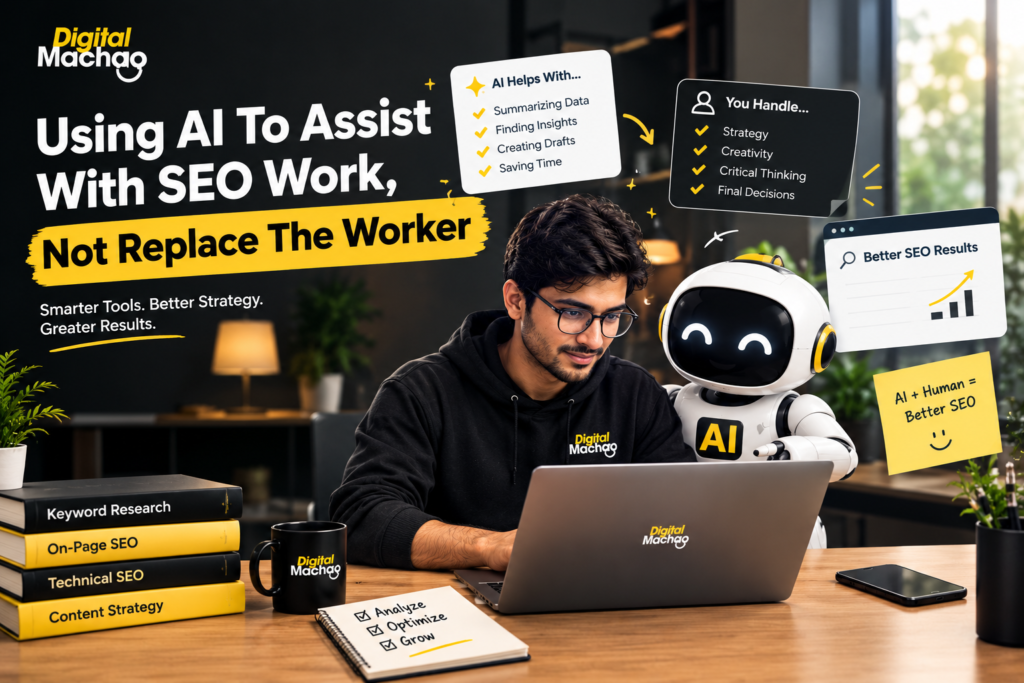
Every few months, a new wave of panic rolls through the SEO industry: “AI is going to replace SEOs.” It makes for a dramatic headline, but it misses what’s actually happening on the ground. The real shift isn’t AI replacing the worker — it’s smart practitioners using AI to assist with SEO work in ways that make them faster, sharper, and more valuable, not obsolete.
According to insights shared by Chris Green, Technical Director and Senior Consultant at Torque Partnership, the right way to think about using AI to assist with SEO work is through a clear line: some tasks demand rigid, deterministic logic that AI shouldn’t be anywhere near, while others genuinely benefit from AI’s ability to interpret, summarize, and explain. Confusing the two is where most AI-in-SEO strategies go wrong.
This article breaks down that framework — what AI should never be trusted to decide on its own, where using AI to assist with SEO work genuinely pays off, and how to build a workflow that keeps the human practitioner firmly in the loop rather than replaced by it.
Why Some SEO Tasks Should Never Be Handed To AI Alone
The starting point for using AI to assist with SEO work responsibly is understanding which tasks are deterministic — meaning they have one correct, verifiable answer — versus which tasks are probabilistic and benefit from interpretation.
Key facts:
- Deterministic SEO tasks include things like whether a page returns an HTTP 404 status code, whether a canonical tag exists on a given URL, how the DOM renders after JavaScript executes, and whether robots.txt actually permits or blocks crawler access.
- Green argues these tasks should run through a “firm framework rather than a probabilistic token-eating word-predictor,” because they produce the same correct answer every single time they’re checked.
- Using AI to assist with SEO work on tasks like these — where a large language model essentially guesses at an answer that software can simply verify — introduces unnecessary risk of error into checks that should be 100% reliable.
Why This Matters
This is the single most important guardrail in any strategy for using AI to assist with SEO work. A 404 status code is not a matter of interpretation — it either returns or it doesn’t. Handing that kind of binary, verifiable fact to a language model, which generates probabilistic text rather than running a deterministic check, introduces a failure point that simply doesn’t need to exist. The practical takeaway: keep technical, verifiable SEO checks running through actual software and crawlers, and reserve AI for the layer that sits above those facts — not for generating the facts themselves.
Where Using AI To Assist With SEO Work Actually Pays Off
Once the deterministic layer is handled by proper tools, there’s real, substantial value in using AI to assist with SEO work on the interpretive side of the job.
Key facts:
- Language models are genuinely effective at converting dense technical data — JSON exports, spreadsheet dumps, crawl reports — into readable, digestible summaries a stakeholder or client can actually understand.
- AI is well suited to explaining what changed between two versions of a page, a site, or a dataset, turning a raw diff into a plain-language explanation.
- Generating ticket descriptions for developers is another strong use case, since it saves practitioners from manually re-explaining the same technical context over and over.
- AI also genuinely helps interpret ambiguous semantic shifts — situations where meaning or intent has changed in a way that isn’t a simple binary fact, but requires judgment-informed explanation.
Why This Matters
This is where using AI to assist with SEO work delivers real, measurable time savings without sacrificing accuracy. None of these use cases ask AI to be the source of truth — they ask AI to take facts that are already established and make them faster to understand, communicate, and act on. That distinction is what separates a genuinely useful AI workflow from a risky one. The AI model provides supporting evidence and explanation; it does not become the final decision-maker on whether something is actually a problem worth fixing.
A Real Experiment: What Happened When AI Judged Instead Of Supported
One of the most instructive parts of this discussion comes from a direct experiment testing the limits of using AI to assist with SEO work.
Key facts:
- Testing an on-device model (Gemini Nano), Green found it performed well at describing DOM changes — accurately summarizing what had shifted in a page’s rendered structure.
- However, the same model struggled significantly when asked to combine multiple structured facts into a nuanced SEO judgment — the kind of multi-factor reasoning an experienced practitioner does almost instinctively.
- Rather than trying to fix this by piling on more detailed instructions or prompts, the practical solution was reassigning the model’s role entirely: instead of asking it to judge findings, it was repositioned to support the practitioner’s own judgment.
Why This Matters
This experiment is a useful real-world test case for anyone experimenting with using AI to assist with SEO work. The instinct when an AI model gets something wrong is often to write a longer, more detailed prompt — adding more rules, more context, more constraints. But the better fix, based on this experience, isn’t a bigger prompt. It’s a smaller job. Describing a change is a task AI handles well. Judging whether that change matters, and what should be done about it, is still a job for the practitioner. Recognizing which category a task falls into — description or judgment — is the real skill in using AI to assist with SEO work effectively.
The Practical Workflow: Facts, Then AI, Then Judgment
Put together, this points to a simple, repeatable three-step workflow for using AI to assist with SEO work without losing control of the outcome.
Key facts:
- Establish the facts with software. Technical, deterministic checks — status codes, canonical tags, rendering behavior, crawl access — run through proper SEO tools and crawlers, not through a language model’s best guess.
- Deploy AI to reduce the effort of interpreting those facts. Once the facts are solid, AI steps in to summarize, explain, translate technical output into plain language, and draft the first version of tickets or reports.
- Apply human judgment where nuance actually matters. The practitioner makes the final call on what the findings mean, what’s worth prioritizing, and what action to recommend — AI supports this decision with context, but doesn’t make it.
Why This Matters
This three-step structure is the clearest practical takeaway for any team currently figuring out how to start using AI to assist with SEO work without overcorrecting in either direction. Skip step one, and you’re trusting AI with facts it can get wrong. Skip step two, and you’re wasting the genuine efficiency gains AI can offer. Skip step three, and you’ve effectively let AI replace the worker rather than assist them — which is exactly the outcome this whole framework is designed to avoid.
Why Keeping The Human In The Loop Actually Matters Long-Term
Beyond the immediate workflow, there’s a deeper argument for why using AI to assist with SEO work — rather than letting it operate independently — protects the profession itself.
Key facts:
- Keeping practitioners actively involved in the process maintains their genuine understanding of the problems they’re solving, rather than letting that understanding atrophy behind an AI-generated summary.
- When a practitioner disagrees with what an AI tool outputs, that disagreement itself becomes useful — it often reveals a weakness in the AI’s interpretation, a gap in the underlying data, or a nuance the model missed entirely.
- Letting AI fully take over judgment-based work risks what’s been described as “deskilling” the profession — a gradual erosion of the critical thinking and pattern-recognition skills that make an experienced SEO practitioner valuable in the first place.
- The end result of a properly scoped approach is genuinely useful tooling that doesn’t require full autonomy to be worth using.
Why This Matters
This is the strongest argument for why using AI to assist with SEO work should remain the industry’s guiding principle, rather than using AI to replace SEO practitioners outright. An SEO who stops questioning AI output, stops double-checking judgment calls, and stops building their own pattern recognition over time isn’t actually getting more efficient — they’re slowly losing the skill set that made them valuable to begin with. The practitioners who come out ahead in this shift won’t be the ones who hand everything to AI. They’ll be the ones who know exactly which parts of their job AI should touch, and which parts still require a human sitting with the data and making the call.
Building Your Own Approach To Using AI To Assist With SEO Work
Based on this framework, here’s a practical checklist for any SEO team or freelancer figuring out where AI fits:
- Map your recurring tasks into two buckets — deterministic (one correct, verifiable answer) and interpretive (requires context, nuance, or judgment).
- Never let AI generate deterministic facts. Status codes, canonical tags, indexability, and crawl access should always come from actual tools, not a language model’s guess.
- Use AI for translation and explanation, not verdicts. Let it turn raw data into readable summaries, draft tickets, and explain diffs — but keep the final “so what does this mean” judgment with a human.
- Test small before scaling up. Run a real experiment, like testing a model on a narrow task, before rolling AI output into client-facing reports or decisions.
- When AI gets something wrong, resist the urge to over-prompt. Consider whether the task itself is simply the wrong size or type for AI to handle, rather than assuming a longer prompt will fix it.
- Protect your own skill development. Keep reviewing AI output critically — treat disagreement with AI as useful signal, not an inconvenience to prompt away.
Conclusion: The Goal Is Augmentation, Not Automation Of Judgment
The conversation around AI in SEO too often gets framed as a binary — either AI replaces SEOs, or it doesn’t matter at all. The far more useful reality sits in between: using AI to assist with SEO work, specifically on the interpretive, explanatory, and translation-heavy parts of the job, while keeping deterministic facts and final judgment calls firmly in human hands.
The practitioners and agencies who get this balance right won’t be racing AI to see who can work faster alone. They’ll be using AI to assist with SEO work in a way that makes their own judgment faster to apply, easier to communicate, and harder to replace.
Key Takeaways
- Deterministic SEO facts should never come from AI. Status codes, canonical tags, and crawl access belong to proper software tools, not a language model’s best guess.
- AI genuinely excels at translation and explanation. Using AI to assist with SEO work on summaries, diffs, and ticket drafts saves real time without sacrificing accuracy.
- A real experiment showed AI struggles with nuanced judgment. When a model couldn’t combine facts into a sound SEO verdict, the fix was narrowing its role, not writing a longer prompt.
- The right workflow is facts, then AI, then human judgment — in that order, every time.
- Keeping humans in the loop protects the profession from “deskilling,” preserving the critical thinking that makes experienced practitioners valuable.
FAQs
1. What does “using AI to assist with SEO work” actually mean in practice?
It means using AI for interpretive tasks — summarizing technical data, explaining changes, and drafting communications — while keeping deterministic, verifiable facts (like status codes and canonical tags) running through proper software, and keeping final judgment calls with a human practitioner.
2. Which SEO tasks should never be handled by AI alone?
Deterministic tasks with one verifiable, repeatable answer — such as HTTP status codes, canonical tag existence, DOM rendering behavior, and robots.txt permissions — should always be checked with actual tools rather than an AI model’s interpretation.
3. Where does AI add the most genuine value in SEO work?
AI is strongest at converting technical data into readable summaries, explaining what changed between versions of a page or dataset, drafting developer ticket descriptions, and helping interpret ambiguous semantic shifts — all tasks that support a practitioner’s judgment rather than replace it.
4. What happens when AI is asked to make SEO judgment calls on its own?
Based on real testing, AI models can struggle to combine multiple structured facts into a nuanced, reliable SEO judgment, even when they handle simpler descriptive tasks well. The better fix is narrowing the AI’s role to support rather than decide.
5. Why does keeping a human in the loop matter for SEO teams using AI?
It prevents the gradual erosion of practitioner skills, often called “deskilling,” and turns moments of disagreement with AI output into useful signals for catching errors or gaps in the data — something a fully automated process would miss entirely.