
ChatGPT Ads And GEO: Where Paid And Earned AI Visibility Fit Together
For the past couple of years, brands have been racing to understand one question: how do you get mentioned inside an AI-generated answer? That race had a name — GEO, or Generative Engine Optimization — and it was, until recently, the only real lever marketers had inside tools like ChatGPT.
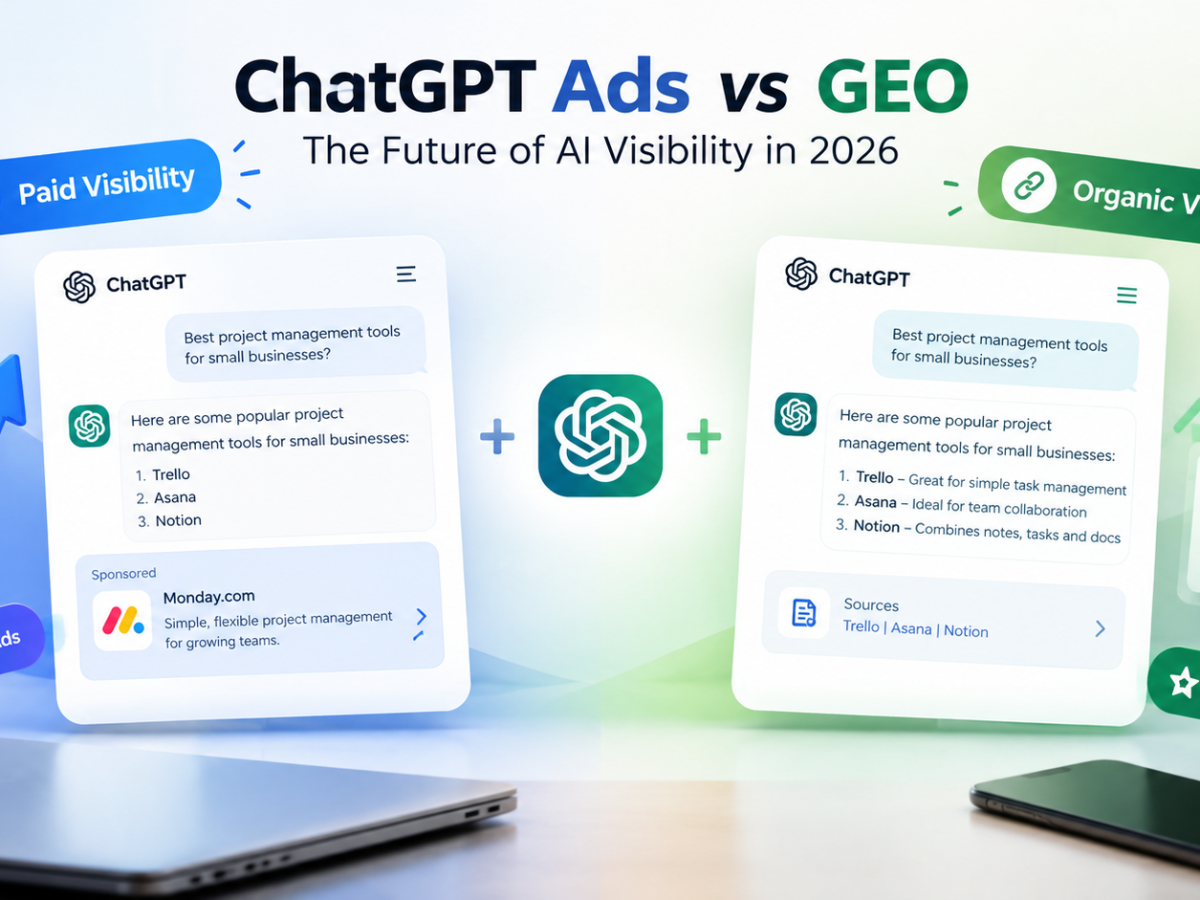
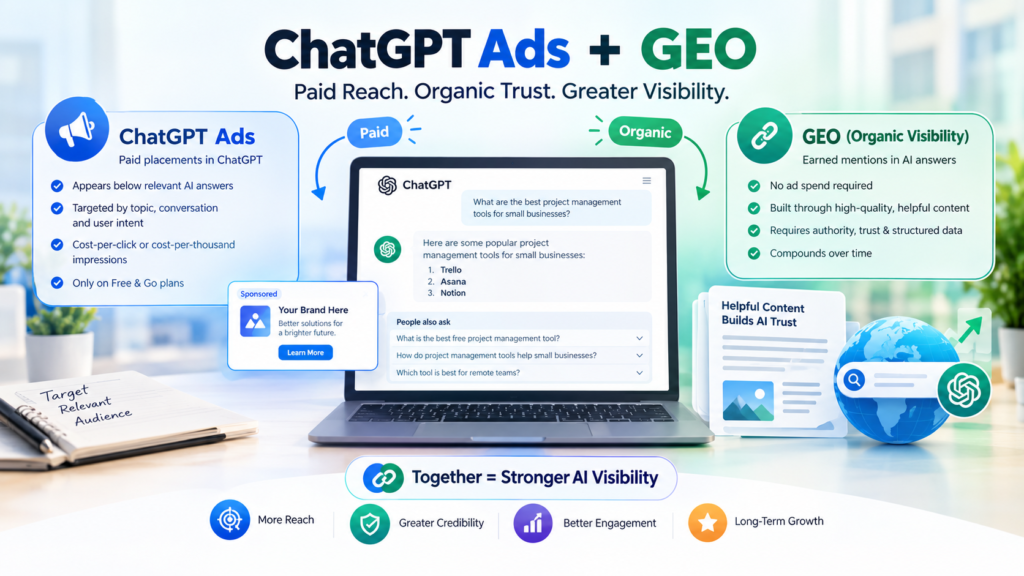
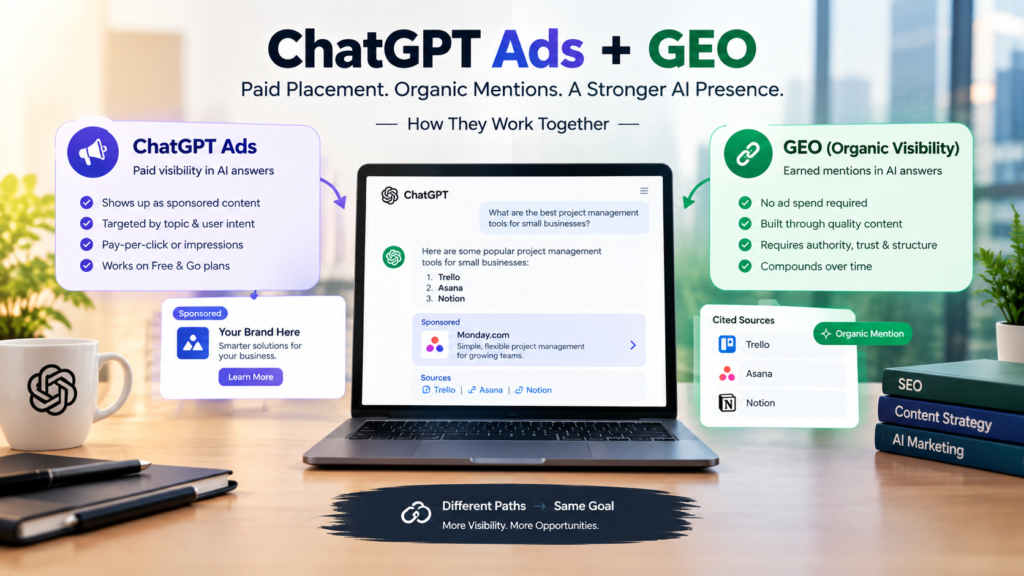
That changed when OpenAI began rolling out ads inside ChatGPT for users on its Free and Go tiers. Ads now appear below relevant AI answers, clearly labeled as sponsored, and separate from the response ChatGPT generates on its own. For marketers, this is a genuinely new moment: for the first time, there are two distinct paths into an AI answer — one you buy, and one you earn.
The problem is that most teams are still treating these as competing strategies instead of one integrated plan. That’s a mistake. Paid placement and organic AI visibility solve different problems, on different timelines, and understanding how they fit together is quickly becoming one of the most important skills in digital marketing.
This article breaks down what ChatGPT Ads actually are, how GEO is different, and three practical ways to make paid and earned AI visibility work as a single system rather than two disconnected efforts.
What Exactly Are ChatGPT Ads?
ChatGPT Ads are a straightforward paid media product. OpenAI shows a sponsored message below a relevant ChatGPT response when the system detects a matching conversation topic, and advertisers pay for that placement — typically on a cost-per-click or cost-per-thousand-impressions basis.
Ad selection is based on the topic of the current chat, prior conversations, and previous ad interactions, and OpenAI has been clear that ads do not influence the AI-generated answer itself, and that user conversations are not shared with advertisers.
Right now, ads only appear for people on ChatGPT’s Free and Go tiers — subscribers on Plus, Pro, Business, Enterprise, and Education plans don’t see them at all. OpenAI has also said it will keep ads out of sensitive categories like health, mental health, and politics, and won’t show them to users under 18.
The appeal for marketers is obvious: it’s a channel you can test, measure, and scale on demand, in a place where a growing share of consumer research and shopping behavior is already happening. But it comes with the same limitation every paid channel has always had — the moment your budget stops, the visibility stops with it.
What Makes GEO Different
GEO, sometimes used alongside the older term AEO (Answer Engine Optimization), is the practice of earning a citation or mention in an AI system’s answer without paying for it. There’s no media buy involved. Instead, brands earn visibility by publishing genuinely useful, clearly structured, easily quotable content, and by building strong signals of expertise and trustworthiness across the web that AI systems can confidently draw from.
The distinction matters because of how these systems actually work. Unlike a human reading a page top to bottom, an AI model extracts specific, discrete claims from a source and attaches a citation to them. If your content doesn’t clearly and accurately describe what you do, the system will struggle to represent your brand correctly — no amount of ad spend changes that underlying problem.
This is also why GEO tends to compound over time in a way paid placement doesn’t. Once a brand earns a reliable, accurate presence in a model’s training and retrieval sources, that presence tends to persist. Multiple industry analyses tracking brand visibility across AI platforms have found that companies running ads without any organic AI foundation see their visibility collapse almost immediately once the ad campaign is paused — in some cases within 48 hours. Paid visibility, in other words, is rented. Earned visibility is owned.
Why Treating Them As Separate Strategies Creates Gaps
The instinct for a lot of marketing teams is to pick one lane — either “we’ll just run ads” or “we’ll just focus on organic AI visibility.” Both approaches leave real gaps in how buyers discover and evaluate a brand.
A brand that relies only on paid placement is essentially borrowing attention it doesn’t structurally own. It shows up when the budget allows and disappears the moment it doesn’t, and it never builds the kind of durable authority that makes an AI system trust it enough to cite it organically.
A brand that relies only on organic GEO work, meanwhile, is playing a much slower game. Earning citations takes time, and in categories where competitors are actively buying placement, sitting out entirely means ceding visibility on exactly the queries that matter most — the ones with strong purchase intent, where a competitor’s paid message might be the only mention showing up at all.
The teams getting this right are the ones running ChatGPT Ads and GEO as a single, integrated plan, measured against the same underlying question: is my brand being seen and chosen inside ChatGPT, through whichever path gets us there?
3 Ways To Make Paid And Earned AI Visibility Work Together Step 1: Audit Where You Already Stand Before Spending Anything
Before deciding whether to buy visibility or earn it, you need a clear baseline. Build a list of prompts your actual buyers would type — not abstract keywords, but real questions like “best project management tool for a 20-person agency” or “alternatives to [competitor] for subscription billing.” Run those prompts through ChatGPT and note three things: whether your brand shows up organically at all, whether the description of your brand is accurate, and which competitors are showing up instead.
This single audit tells you almost everything you need to know about where to focus first. If your brand is largely invisible or misdescribed in organic answers, throwing paid budget at the problem won’t fix the underlying issue — it will just mask it temporarily.
Suggested KPIs to track:
- Baseline share of voice: How often your brand appears across your fixed prompt set compared to named competitors, tracked before any paid or GEO investment begins.
- Citation accuracy score: The percentage of organic mentions that describe your product or service correctly, used as the starting point for every future audit.
Step 2: Use GEO To Build The Foundation, Ads To Amplify It
The strongest sequencing, based on how AI platforms currently reward brands, is to build organic AI visibility first and treat paid placement as an amplifier layered on top — not the other way around. GEO earns visibility that compounds without ongoing spend; ChatGPT Ads buy visibility that disappears the moment spend stops.
In practice, that means prioritizing clear, well-structured content that accurately describes your product, backed by consistent messaging across your website, review platforms, and any place AI systems pull information from — including schema markup that helps models parse your capabilities correctly. Once that foundation is in place, ChatGPT Ads become far more effective, because a buyer who sees a sponsored message and then checks the organic answer finds a consistent, credible brand story rather than a confusing gap between what the ad claims and what the rest of the internet says.
There’s also a timing argument for testing ads now regardless of how strong your organic foundation is. When your brand doesn’t advertise in a relevant conversation, that ad slot doesn’t stay empty — it typically goes to whichever competitor did show up.
Suggested KPIs to track:
- Paid-to-organic consistency rate: How closely a paid ad’s claims match the accurate, organic description of your brand elsewhere in the same conversation.
- Post-campaign visibility retention: How much of your AI visibility holds up in the weeks after a paid campaign pauses — a direct signal of how strong your organic foundation actually is.
Step 3: Decide Per Query, Not Per Channel
Not every query deserves the same strategy. High-intent, commercial queries — the kind a buyer types when they’re close to a decision — are exactly the queries advertisers are willing to pay a premium for, and they’re also the queries where a competitor’s paid placement can quietly steal attention if you’re not present. Early-stage, advice-style queries, on the other hand, tend to reward brands that show up as a genuinely useful, cited source rather than an obvious advertiser.
Rather than deciding “we do ads” or “we do GEO” as a blanket company policy, map your priority prompts by buying stage and decide, prompt by prompt, whether the smarter move is to buy the placement, earn the citation, or do both. This is where treating paid and earned visibility as one measurement system — rather than two separate budgets reporting to two separate teams — makes the real difference.
Suggested KPIs to track:
- Competitor displacement rate: How often a competitor’s paid or organic mention appears instead of yours on your priority high-intent prompts.
- Query-level ROI: Cost and visibility outcome compared side by side for the same prompt across both the paid and organic path, so budget can shift toward whichever is actually working for that query.
Conclusion: One Question, Two Paths
ChatGPT Ads didn’t replace GEO, and GEO isn’t a defense against having to eventually pay for placement. They’re two answers to the same question: will a buyer see and choose your brand inside an AI conversation? Paid media gives you a lever you can pull immediately, on your own schedule, measured in clicks and impressions. Earned visibility gives you something that compounds and survives long after any single campaign ends.
The brands that will come out ahead as AI-native search matures aren’t the ones with the biggest ad budgets or the most content published. They’re the ones who stop treating “paid” and “earned” as competing line items and start treating them as one visibility strategy, measured against the same goal, adjusted query by query as the landscape keeps shifting under everyone’s feet.
Key Takeaways
- ChatGPT Ads and GEO solve different problems. Ads buy immediate, measurable placement below an AI answer. GEO earns a citation inside the answer itself, without any media spend.
- Paid visibility disappears; earned visibility compounds. Multiple platform studies show AI visibility built purely through ads can collapse within days of a campaign pausing, while organic citations tend to persist.
- Audit before you spend. Running your buyers’ real questions through ChatGPT reveals whether your core problem is visibility, accuracy, or both — and that should decide where your first investment goes.
- Treat this as one plan, not two budgets. The strongest brands sequence GEO as the foundation, use ads as an amplifier, and decide per query which path — or both — makes sense.
Frequently Asked Questions
1. What are ChatGPT Ads?
ChatGPT Ads are sponsored messages OpenAI shows below relevant AI answers for users on the Free and Go tiers. They are clearly labeled as ads, don’t influence the AI’s actual response, and are priced on a cost-per-click or cost-per-thousand-impressions basis.
2. What is GEO, and how is it different from AEO?
GEO (Generative Engine Optimization) and AEO (Answer Engine Optimization) both refer to earning organic visibility inside AI-generated answers, across tools like ChatGPT, Gemini, and Perplexity. Neither involves paid placement — both rely on structured, accurate, citation-worthy content.
3. Should a brand choose ChatGPT Ads or GEO?
Not exclusively. The strongest approach uses GEO to build a durable organic foundation and layers ChatGPT Ads on top for immediate, measurable visibility on high-intent queries — treating both as one coordinated strategy rather than competing options.
4. Do ChatGPT Ads affect the accuracy of AI answers?
According to OpenAI, ads do not influence the content of ChatGPT’s generated answers, and user conversations are not shared with advertisers. Ads appear as a separate, clearly labeled element below the response.
5. How can a brand check its current AI visibility before investing in either strategy?
Run the exact questions your buyers would ask through ChatGPT and note whether your brand appears, how accurately it’s described, and which competitors show up instead. This baseline audit should guide whether to prioritize paid, organic, or both.
6. Why does organic AI visibility disappear so quickly without ads?
Visibility built purely through paid placement depends entirely on active ad spend. Without a genuine organic foundation — accurate, well-structured content that AI models can confidently cite — there’s nothing left for the system to reference once the campaign stops.