
Google Adds Local Businesses To EEA Search Result Units: What It Means For Local SEO in Europe
Google has implemented another major search format update in the European Economic Area (EEA). If you run a local business, handle local SEO campaigns or operate digital marketing of brands providing services in EEA, then this news is worth your attention.
On September 18, 2026, Google updated its Search documentation to include local business queries among those supported by the two new units implemented in EEA. Let’s find out what Google did and why this is a major step in the evolution of local SEO.
What Exactly Did Google Change?
Google added support of local business queries in the two search units it rolled out in the European Economic Area this month. Google made this change on September 18 and updated Search Central documentation for both aggregator unit and supplier unit on the same date.
The point is that now local businesses are included among those units along with hotels, flights, long distance trains or buses, and products. When SEJ’s Matt G. Southern talked about this rollout on September 8, he mentioned that the supplier unit page used examples of brick-and-mortar business owners and plumbers. However, the page didn’t mention the inclusion of local queries before. Now, it does.
Once again, Google kept its statement pretty short. According to the changelog, Google simply said that “the aggregator unit and supplier unit now support local business queries”.
In other words, the units can now include both directory-type content and individual businesses. Previously, it wasn’t the case.
Understanding the Two Result Units
To understand the update better, let’s explain the two units introduced in the EEA a week ago, as the new feature is built upon them.
The Aggregator Unit
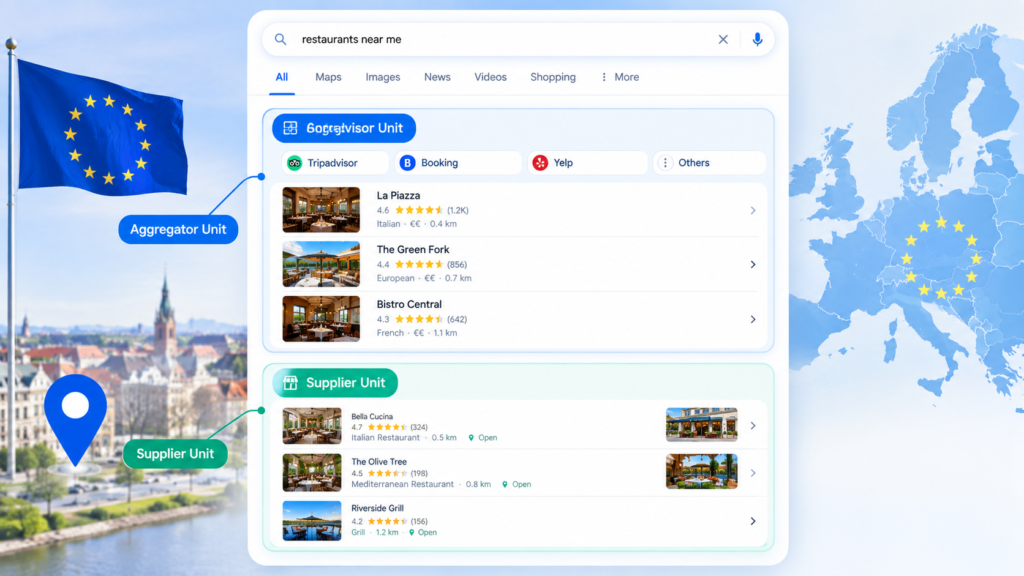
This multi-provider unit is designed for Vertical Search Services (VSSs), including Online Travel Agencies (OTAs), Comparison Shopping Services, metasearch engines and directories. Practically, this is where approved directories and comparison sites compete with their listings.
In the aggregator unit, eligible aggregators provide the results relevant to the user’s query and the results provided by the top-ranked provider are automatically expanded. User can choose the aggregator to use from the list of those that are eligible for that query, but only one aggregator unit appears.
The requirement to participate in the aggregator unit includes approval as VSS, providing the necessary data and meeting the established quality standards. This is not something a brick-and-mortar business can provide on its own, as this unit is designed for aggregating sites and directories.
The Supplier Unit
This is the unit that is more interesting for local businesses, as it is directly related to individual providers. The website should be intended for users from the EEA and the business itself should be a direct provider able to appear for hotel, flight, long distance train or bus or product queries – and now local business queries as well.
And the best thing about this unit for local business owners is that there is no need for submitting any additional data to appear in this feature. It means that your business can appear there just because Google can crawl the website. In other words, the participation in the supplier unit doesn’t require a data feed, though such feeds can enhance supplier results, if available.
There is one caveat though. The visibility in the supplier unit is not entirely independent. According to one analysis, a hotel or business appears in the supplier unit in the moments when the aggregator unit was already triggered for that query.
Why This Update Is Important Now
Google has not started working on the redesign of EEA search results recently. Back in early 2024, Google launched new search experiences for flights, hotels, ground transportation, vacation rentals, jobs, local business, and things to do queries in the EEA as part of its changes in search to comply with regulations concerning this region.
What’s changed now is the practical inclusion of local businesses in both units simultaneously. Previously, local queries existed in a sort of gray area. They were not formally supported by any unit, though mentioned as a future direction. With this September 18 update, the ambiguity is removed. Local businesses, such as restaurants, plumbers, hair salons, dentists, and others can now enter this new search experience.
Also, for the sake of context, it is worth mentioning that the units are regionally specific. The aggregator unit is currently available only to users in the EEA, South Africa, and Türkiye, as Google stated on September 8, 2026. So, if you don’t serve the EEA users, this update isn’t applicable to you. However, it may change in the future as Google expands these features globally.
How Local Businesses Should Prepare
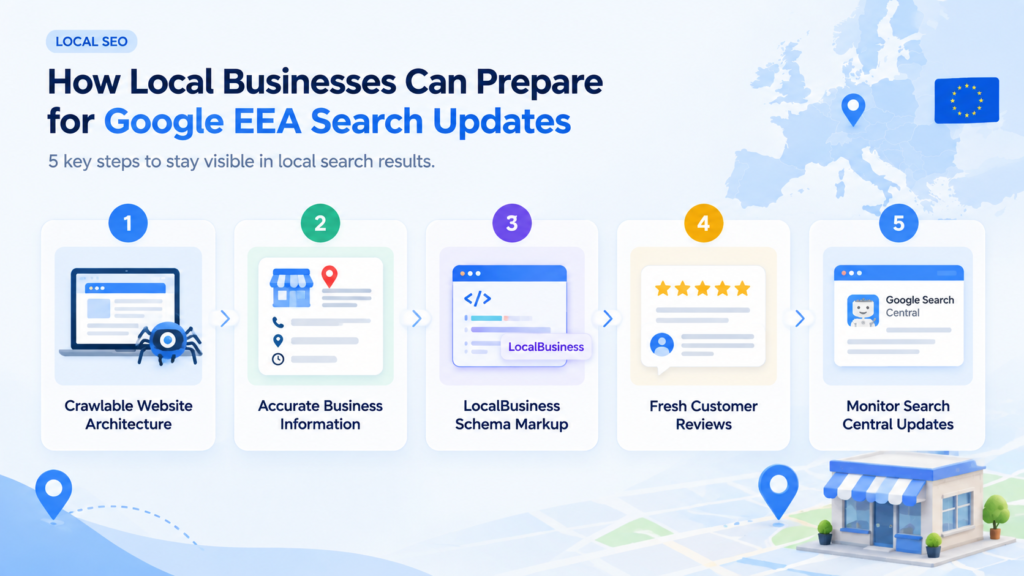
Although there is no need for the data feed to participate in the supplier unit, the businesses that will benefit from the update the most will be the ones focusing on basic SEO practices. According to Google’s own guidance, the priority areas are:
- Clean, crawlable website architecture. As the supplier unit inclusion relies heavily on the crawler capabilities of Google, you should ensure that your website architecture, speed, and mobile experience are good enough.
- Accurate and consistent business data. The priority in the guidance by Google on this issue is on entity-level data quality: correct categories, real photos, verified ratings, amenities, opening hours and prices corresponding to the landing page. These are the same signals that affect your presence in local packs, product listings, and AI-generated answers everywhere.
- Structured data and schema markup. Although it is not required by Google for the supplier unit, LocalBusiness schema will help Google’s crawler to understand the details about your business quickly and correctly – categories, hours, address, and reviews.
- Fresh and verified reviews. As verified ratings are included in the quality signal set Google uses, it is beneficial to manage your review profile actively (respond to the reviews, encourage customers to post their opinions).
- Monitor Google Search Central changelog. As Google rolls out these features incrementally and documents it only in changelog entries, it is the best way to catch any future expansions in time.
What This Update Means For SEO and Marketing Teams
If you manage the local businesses with any EEA footprint, then the following actions should be considered immediately:
- Audit business listings on Google Business Profile and website to ensure the data is accurate across the sources, as it affects how Google represents the business;
- Check local schema markup and ensure that opening hours, address, and categories match what is on the landing page;
- Track the SERP appearance for local queries in EEA markets to understand if supplier and aggregator units start appearing there;
- Educate your clients that this is not a paid placement – inclusion is driven by data quality and crawlability, not ads, as many local business owners think about their search visibility.
The update also supports the ongoing trend: Google is more and more building dedicated result formats for different query types (travel, products, local services) instead of relying on the traditional 10 blue links or even local packs many SEOs optimized for in the previous years. The businesses adapting structured data now will likely benefit from the evolution of these formats in the future.
Final Thoughts
The addition of local business queries in both aggregator and supplier units is the natural step in the evolution of EEA search redesign that started earlier this year. Although Google’s statement on this matter consisted of just one line, the implications it has for the local SEO strategy, entity data management, and competition of businesses against aggregators and directories are significant.
So, for local business owners and marketers, the conclusion is the following: this is a low-effort, high-value opportunity. As inclusion in the supplier unit doesn’t require data feed, just a clean, crawlable and consistent website can be enough for this. Provided that your entity data (categories, hours, photos, ratings) is correct and accurate.
Also, pay attention to Google Search Central changelog. Considering the speed of updates this month, there is a chance that Google will refine these EEA-specific units further.
Frequently Asked Questions
Q1: What are the aggregator unit and supplier unit in Google Search?
These two units are used to display listings of vertical search services and individual providers. The aggregator unit displays listings from approved directories and comparison platforms, with the top-ranked provider being expanded. The supplier unit displays individual hotels, airlines, product sellers, and now local businesses.
Q2: Does this update apply to businesses outside the EEA?
No. As of now, these result units are limited to the users in the EEA, South Africa, and Türkiye. Businesses serving non-EEA audiences aren’t affected by this update, though Google can expand coverage in the future.
Q3: Do local businesses need to submit data feed to appear in the supplier unit?
No. According to Google, there is no need for the additional data, except the one available through the standard web crawling. However, supplier results can be enhanced further if a data feed is available.
Q4: Which kinds of local businesses are eligible?
According to Google, these are brick-and-mortar business owners and plumbers, as examples. In other words, these are direct providers of EEA users that can plausibly appear for local business queries.
Q5: How can I improve my chances of appearing in these units?
The priority areas are accurate business categories, real photos, verified ratings, correct amenities, opening hours, and pricing corresponding to the landing pages. These are the same signals Google uses in local packs, product listings, and AI-generated answers.
Q6: Is this a paid feature?
No. Placement is not driven by any advertising spend. It is driven by data quality, crawlability, and eligibility criteria established by Google.