
Digital Marketing Agencies in Delhi
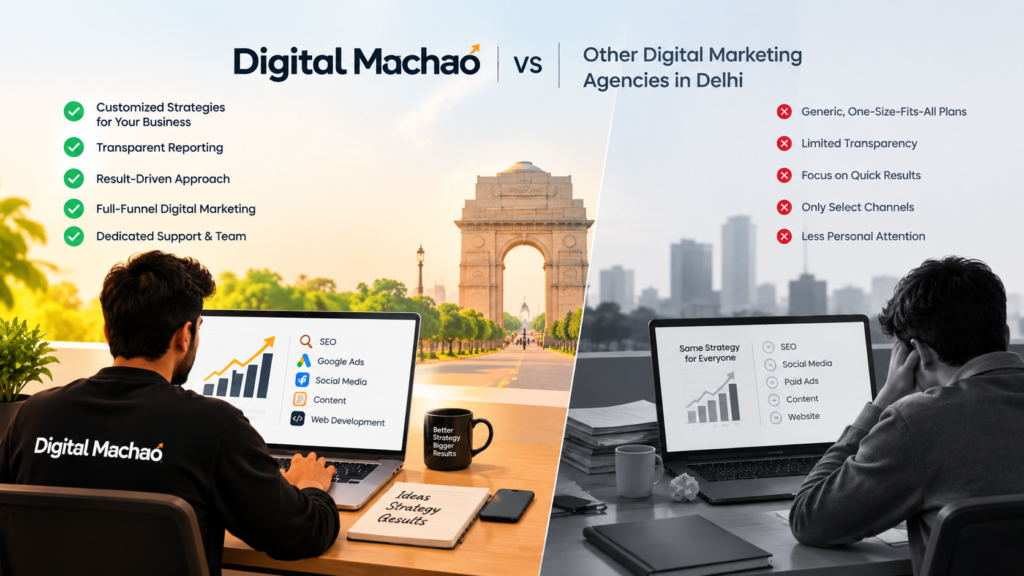
How Digital Machao Is Different From Top Digital Marketing Agencies in Delhi Search “digital marketing agency in Delhi” and you’ll get thousands of results. Scroll through a dozen of their homepages and something strange happens: they all read the same. SEO, PPC, SMM, web development, content marketing, email marketing — the same seven services, the same “360-degree solutions,” the same stock photography of people pointing at growth charts. For a business owner trying to choose one, this sameness is the actual problem. When every agency claims to do everything, “different” stops meaning “better” and starts meaning “unproven.” So the real question isn’t “who offers the most services” — it’s “who has actually built the depth to make one of those services work at a level that moves revenue.” This is where the comparison between a full-service generalist and a specialist like Digital Machao gets interesting — not because one is universally better than the other, but because they’re built to solve different problems. The Generalist Model: Why Most Delhi Agencies Look Identical Delhi’s digital marketing ecosystem is large and genuinely competitive — agencies here range from boutique two-person operations to firms with hundreds of employees serving global clients. Most of them operate on the same structural model: a broad service menu, account managers who route work to specialist teams or freelancers, and pricing built around retainer packages that bundle SEO with social media, paid ads, and content. That model isn’t wrong — it exists because most businesses genuinely need multiple channels working together. But it has a predictable weak point: breadth is expensive to maintain at depth. An agency running SEO, PPC, SMM, influencer marketing, and web development simultaneously for dozens of clients across every industry can rarely go deep enough in any single discipline to solve genuinely hard problems in that discipline. Ecommerce SEO is one of those genuinely hard problems. Why Ecommerce SEO Doesn’t Fit the Generalist Playbook SEO for a five-page brochure website and SEO for a 5,000-SKU online store are not the same skill, even though they share a name. Ecommerce SEO involves a specific set of technical and structural challenges that rarely come up anywhere else in digital marketing: Faceted navigation and filter URLs that can generate thousands of near-duplicate pages if left unmanaged, silently draining crawl budget. Out-of-stock and discontinued product handling — what happens to a page’s SEO value when the product it was built around disappears. Product schema and structured data at scale, across catalogues that change weekly. Category architecture that has to satisfy search intent, site navigation, and inventory logic simultaneously — three needs that often conflict. Duplicate content across variants — the same product in five colours and three sizes, all fighting each other in search results if not handled correctly. Migration risk — ecommerce platforms change (Shopify to Shopify Plus, WooCommerce to a headless build) far more often than brochure sites do, and every migration is a moment where rankings can be lost overnight. A generalist agency’s SEO team, built to service everything from law firms to restaurants to SaaS startups, typically treats ecommerce as “SEO, but with a product feed.” That gap is exactly where a specialist positioning — building the agency’s entire SEO practice around ecommerce specifically — earns its differentiation. It’s not a marketing claim; it’s a structural choice about where the team’s hours, tools, and case studies concentrate. Where the Difference Actually Shows Up 1. The default starting point is technical, not promotional A generalist SEO engagement often starts with keyword lists and content calendars. An ecommerce-focused approach typically starts with a technical and architectural audit — crawl efficiency, indexation of filtered pages, canonicalization, site speed under real product-image load, and schema coverage — because in ecommerce, technical debt caps everything else. You can publish excellent product copy on a page Google can’t efficiently crawl, and it will underperform regardless of quality. 2. Category pages get treated as primary real estate In most SEO programs, category or collection pages are afterthoughts behind blog content. In ecommerce SEO specifically, category pages are often the single highest-leverage asset on the site — they capture head commercial-intent terms (“waterproof hiking boots,” “organic baby formula”) that carry real purchase intent. A specialist’s process usually weights strategy and content investment toward these pages first, rather than defaulting to blog-led SEO. 3. Reporting is revenue-anchored, not vanity-metric-anchored “Rankings improved” and “traffic is up” are easy to report and easy to misread. An ecommerce-specific practice tends to report against revenue-adjacent numbers: organic revenue by category, conversion rate by landing page type, revenue per organic session, and blended customer acquisition cost including the organic contribution. This isn’t a superficial dashboard choice — it reflects whether the team actually understands how organic traffic turns into a sale, not just a session. Where a Generalist Agency Still Makes Sense Fairness matters here, because not every ecommerce brand needs a specialist, and not every business is ecommerce. A generalist full-service Delhi agency is often the better fit when: You need tightly coordinated multichannel campaigns — a product launch requiring paid social, influencer seeding, PR, and SEO to move in lockstep under one roof. Your business isn’t ecommerce. A B2B services firm, a local clinic, or a SaaS company has different SEO priorities entirely (lead-gen funnels, comparison content, local pack rankings) where ecommerce-specific expertise adds little. You want a single vendor for everything, including brand design, web development, and offline-to-online campaigns, and are comfortable with a shared team rather than a discipline-specific one. Budget favors bundled retainers over paying separately for a specialist per channel. A specialist ecommerce SEO partner tends to make more sense when the store’s growth is genuinely bottlenecked by organic acquisition, technical SEO debt, or catalogue-scale content problems that a generalist team’s bandwidth can’t absorb. What to Actually Ask Before Choosing Rather than taking any agency’s “we’re different” claim at face value — including this one — ask questions that expose real depth: “Walk me through how you’d handle faceted navigation